
TL;DR

Get business pricing on monitors, keyboards and dev gear
- Business-only prices and quantity discounts
- Tax-exempt purchasing
- Multiple users, one account, clear invoices
Neufangled Robotics presents Stringman, a cable-driven robot priced at $795 that uses four ceiling-mounted anchors to move a gripper through a room. The company lists a 1.9 kg average payload in a specified 7-by-7-by-3-meter room and says its hardware designs and software are open source. Independent performance, safety and pricing details have not been supplied in the provided material.
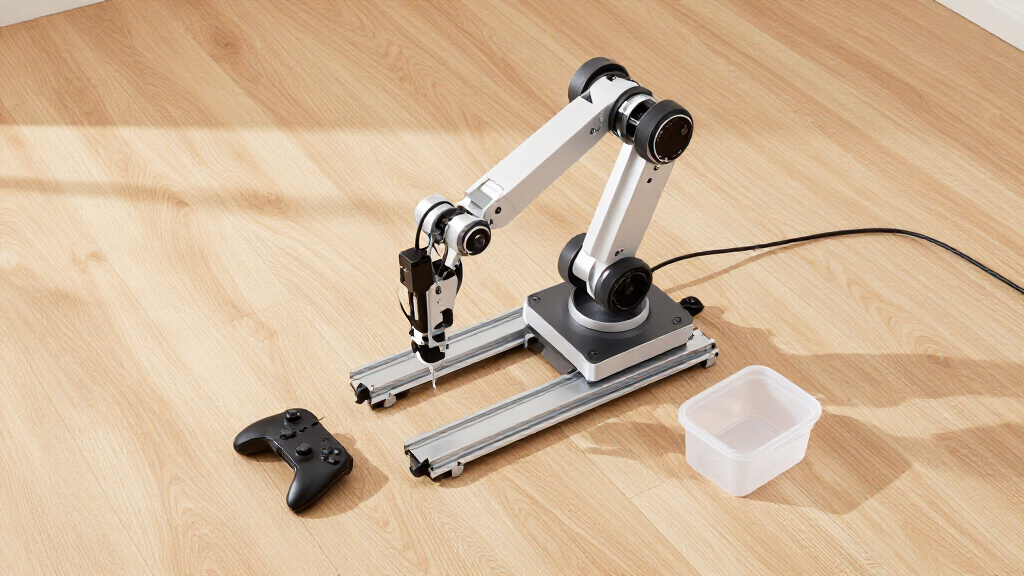
Neufangled Robotics is presenting Stringman, a $795 open-source room-scale robot that suspends a gripper from lines connected to four ceiling-mounted anchors. The company says the system can move objects across a room with an average payload of 1.9 kilograms in a specified 7-by-7-by-3-meter space, offering a different approach from conventional robotic arms that work within a fixed radius.
Stringman uses four motors at the room’s corners to control lines attached to a central gripper. Rather than placing a wheeled robot or articulated arm on the floor, the setup moves the gripper overhead, which Neufangled says lets it reach floor areas that may be crowded with equipment or other obstacles. The system’s listed traverse speed is about 0.4 meters per second.
The company specifies an average payload of 1.9 kilograms and a maximum of up to 2.2 kilograms near the floor, with those figures dependent on room geometry and the system’s stated 28-newton line-tension limit. Its comparison with a seven-joint arm assumes a particular 0.75-meter arm and specified actuators; Neufangled reports average payloads of 1.9 kg for Stringman and 0.32 kg for that arm. These are company-provided figures, not an independent comparative test.
The published specifications describe camera-equipped anchors and gripper, Raspberry Pi computers on the robot, and a separate computer running the controller. Neufangled says mechanical CAD, circuit-board designs, software, build instructions and a bill of materials are available, and identifies the project as open source and OSHWA-certified. The listed system includes 3D-printed parts and is intended for installation on suitable wall studs or structural columns.
A Room-Scale Alternative to Arms
Stringman’s pitch is that coverage of a room, rather than dexterity within a small work envelope, can be the useful measure for some home labs and robotic workspaces. If its stated reach and payload are achieved in a particular installation, one overhead system could carry parts between stations without requiring a mobile base to navigate floor clutter or a separate arm at each location.
The price and open hardware may make the design relevant to researchers and hobbyists who want to build or modify a larger-area robot. But the listed $795 price alone does not establish the full cost of a working installation: users also need a compatible room, mounting hardware, a controller computer and time for setup. The system also leaves lines across the room while installed, a practical trade-off that could limit its use in shared or frequently reconfigured spaces.
Products Worth Considering

Therabody SmartGoggles 2nd Gen Heated Eye and Temple Massager

LEVOIT Vital Pet Pro Smart Air Purifier

Levoit Core 600S-P Smart Air Purifier for Large Rooms
As an affiliate, we earn on qualifying purchases.
How the Cable System Works
In a conventional serial robot arm, joints and links set the arm’s reach. Stringman instead uses lines running from four anchors to position a gripper inside a defined work area. The company says the lines share the lifting load, with payload changing across the room according to the lines’ geometry; its published average and maximum figures apply to stated room and tension conditions rather than every possible installation.
Neufangled lists compatible room dimensions, mounting requirements and a calibration process. It says the anchors can be fixed near the ceiling to wall studs or strapped to structural columns, and that calibration adapts the system to the room. The company also describes a locally hosted interface and says the robot can operate on a local Wi-Fi network without sending data outside it. Remote operation is a separate option that requires account binding, according to the product material.
““Tension is all you need.””
— Neufangled Robotics
Performance and Installation Questions
The supplied material is a company product description, and it does not include independent testing of payload, speed, positioning accuracy, reliability or the comparison with a conventional arm. Neufangled says the project has accumulated about 1,000 hours of testing in real homes, but provides no test protocol, detailed results or breakdown of the conditions in that testing.
The source also does not give a dated launch schedule or clarify whether the $795 figure covers all parts needed for a complete installation, shipping or taxes. Actual performance will depend on room dimensions, anchor placement, mounting strength and obstructions. The company says a 28-newton tension limit causes the motors to relax so the lines can be pulled loose, but the available description does not provide independent safety certification or a complete account of risks in different household settings.
Build Guides and Real-World Use
Neufangled directs prospective builders to its bill of materials, CAD, code and build guide, along with picture and video installation guides. The next practical test for readers will be whether those materials support repeatable builds and whether the robot’s advertised payload and room coverage hold up in different homes and workspaces.
The company also describes a Python API and an MCP server for connecting Stringman to automated workflows, as well as tools for collecting training data and running robot-learning models. The source does not specify a dated release or update schedule. Further independent measurements, clearer complete-build pricing and documentation of safety and reliability would help establish how broadly the system can be used.
Key Questions
What is Stringman?
Stringman is a cable-driven robot from Neufangled Robotics. Four motors mounted near the ceiling control lines that position a gripper across a room.
How much payload can it carry?
Neufangled lists an average payload of 1.9 kilograms and up to 2.2 kilograms near the floor. The figures are company specifications tied to room geometry and a 28-newton line-tension limit; they have not been independently verified in the supplied material.
Is Stringman open source?
Neufangled says its mechanical CAD, PCBs and control software are published, along with STL files, a bill of materials and a build guide. The company describes the project as OSHWA-certified.
What does installation require?
The product material calls for a room with secure mounting points, such as wall studs or structural columns, plus a drill and a ladder. A separate computer runs the controller, and the system requires room-specific calibration.
Do the lines remain visible in the room?
Yes. Neufangled says the lines remain installed but can be parked near the ceiling when the robot is not in use. The company also says room layouts with obstructions, including some low-hanging fixtures, may not be suitable.
Source: neufangled.com