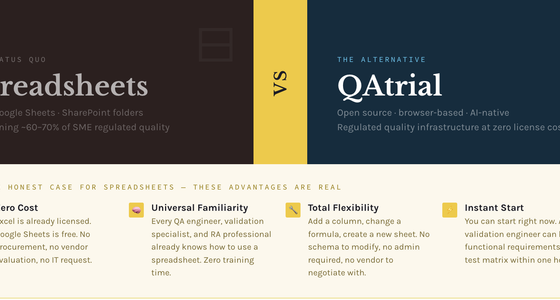
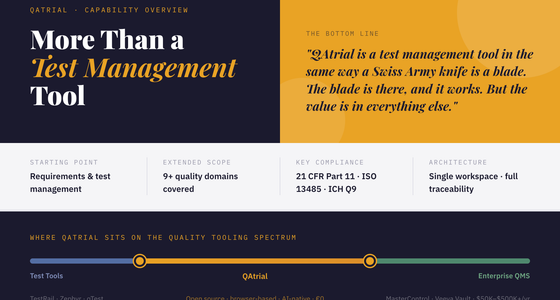
Quality management in regulated industries has a tooling problem. Enterprise platforms like Veeva Vault and MasterControl cost six figures annually and take months to deploy. Smaller teams default to spreadsheets and SharePoint folders. Neither option serves the growing number of organizations that need serious quality infrastructure without the overhead of a traditional QMS rollout.

Get business pricing on monitors, keyboards and dev gear
- Business-only prices and quantity discounts
- Tax-exempt purchasing
- Multiple users, one account, clear invoices
QAtrial is a browser-based quality workspace designed for regulated industries. It runs entirely in your browser, stores data in localStorage, requires no server, and is developed privately and is not publicly available. Version 3.0 covers requirements management, test management, risk assessment, CAPA lifecycle, design controls, audit trails, electronic signatures, AI-assisted compliance analysis, and regulatory-aware project templates across 37 countries and 10 industry verticals.
This article explains what QAtrial does, who it is built for, and how its architecture differs from conventional quality tools.
The Core Model: Country x Vertical x Type x Modules
Every QAtrial project is defined by four dimensions:
Country determines which regulatory authority templates apply. A project set to the United States loads FDA-centric requirements referencing 21 CFR Part 11, 21 CFR 820 (now QMSR), and ICH guidelines. A project set to Japan loads PMDA references. EU member states inherit a shared EU base layer with country-specific overlays on top.
Vertical determines the industry domain and the standards that govern it. QAtrial supports ten verticals: Pharmaceuticals, Biotechnology, Medical Devices, CRO/Clinical Research, Clinical Laboratories, Logistics/GDP, Software and IT (GAMP/CSV), Cosmetics/Chemical, Aerospace, and Chemical/Environmental. Each vertical loads its own regulatory standards, risk taxonomy, and compliance requirements.
Project Type determines the execution context. Options include Software/Web App, Embedded/IoT, Quality System (QMS), Validation (IQ/OQ/PQ), Clinical, Compliance/Audit, and Supplier Quality. Each type adds context-specific template content within the selected vertical.
Quality Modules are composable blocks that address specific quality control domains. There are 15 modules: Audit Trail, Electronic Signatures, Data Integrity (ALCOA+), Change Control, CAPA, Deviation Management, Training, Supplier Qualification, Complaint Handling, Risk Management, Document Control, Backup/DR, Access Control, Validation/CSV, and Traceability Matrix. You select any combination during setup. Modules compose on top of country and vertical templates without creating duplicates.
This four-dimensional model means a medical device project in Germany produces fundamentally different requirements and test templates than a pharmaceutical validation project in Japan. The templates are not cosmetic variations. They reference the actual regulatory clauses, authorities, and standards that apply in each context.
Products Worth Considering

Oral-B iO5 Rechargeable Electric Toothbrush with 5 Cleaning Modes and Travel Case, White

Therabody Theragun Prime 6th Generation Deep Tissue Massage Gun, Navy

Philips Sonicare ProtectiveClean 5300 Rechargeable Electric Toothbrush with 3 Brush Heads, Black
As an affiliate, we earn on qualifying purchases.
What QAtrial Actually Does
At its foundation, QAtrial manages requirements and tests. You create requirements with auto-generated IDs (REQ-001, REQ-002), assign statuses (Draft, Active, Closed), and attach metadata including risk level, regulatory references, tags, and evidence hints. You create tests (TST-001, TST-002) with statuses (Not Run, Passed, Failed) and link them to requirements in an n:m relationship.
From that foundation, the system extends into several areas that pure test management tools do not cover:
Risk Management. An interactive 5×5 severity-by-likelihood matrix with vertical-specific risk taxonomies. Medical device projects use ISO 14971 categories. Pharmaceutical projects use ICH Q9. Software projects use GAMP 5 risk classifications.
CAPA Lifecycle. Corrective and Preventive Action records with a full lifecycle (open, investigation, in_progress, verification, resolved, closed), evidence management, and AI-generated root cause analysis suggestions when tests fail.
Design Controls. A Kanban-style board implementing the seven-phase design control workflow: User Needs, Design Input, Design Output, Verification, Validation, Transfer, Released. Phase advancement is gated by approval status. DHF, DMR, and DHR document containers with version control.
Audit Trail and Electronic Signatures. Every CRUD operation is logged automatically with timestamps, user identification, and diffs. Electronic signatures comply with 21 CFR Part 11 and EU Annex 11, including password re-authentication and a 15-minute verification window.
AI Compliance Co-Pilot. Six AI capabilities: test case generation from requirements, risk classification, gap analysis against regulatory standards, CAPA suggestions, executive compliance briefs, and validation summary reports. The AI supports five provider presets (Anthropic, OpenAI, OpenRouter, Ollama, LM Studio) with purpose-scoped routing so you can assign different models to different tasks.
ISO 13485 Gap Assessment. A dedicated assessment tool with two modes: keyword-based matching that works without any AI provider, and AI-powered deep analysis that evaluates requirements against all 27 ISO 13485:2016 clauses. Particularly relevant for organizations navigating the FDA QMSR transition.
Reporting. Six report types including Validation Summary Reports, Executive Compliance Briefs, Regulatory Submission Packages (formatted per authority), traceability matrices, gap analysis reports, and risk assessment exports.
Who QAtrial Is Built For
QAtrial serves specific roles within regulated organizations:
QA Engineers use it as their daily workspace for managing requirements, executing tests, documenting evidence, and maintaining traceability. The enriched metadata on each requirement (regulatory references, risk levels, evidence hints) reduces the research burden that typically falls on QA staff.
Validation Specialists use it for IQ/OQ/PQ protocol management, computer system validation, and generating validation summary reports. The template system pre-populates requirements referencing the correct standards for their vertical and country.
Regulatory Affairs Professionals use the gap analysis and compliance readiness scoring to assess how well their quality system covers applicable standards. The ISO 13485 assessment and QMSR gap tools are directly relevant for regulatory submissions and audit preparation.
Quality Managers use the seven dashboard views to monitor coverage metrics, risk distribution, CAPA status, evidence completeness, and overall compliance readiness across projects. The portfolio dashboard provides multi-project oversight.
R&D Leads in medical device and software companies use the design control Kanban to manage design history files and ensure design gates are properly documented before advancement.
The tool is particularly relevant for organizations in these situations: medical device companies preparing for the FDA QMSR transition (effective February 2026), startups and mid-size companies that need quality infrastructure but cannot justify enterprise QMS costs, teams currently managing quality records in spreadsheets, and organizations in regulated industries that require data sovereignty and cannot use cloud-hosted QMS platforms.
What Makes It Different
Four characteristics distinguish QAtrial from both enterprise QMS platforms and lightweight test management tools:
Developed privately. QAtrial is developed privately and is not publicly available.
AI-native, not AI-bolted. The AI capabilities are integrated into the core workflows, not added as a separate module. When you look at a requirement, you can generate tests or classify risk directly. When a test fails, CAPA suggestions appear in context. The AI operates on a human-in-the-loop principle: it proposes, you review and accept.
Self-hosted with no server dependency. QAtrial runs entirely in the browser. Data stays in localStorage. There is no cloud service to subscribe to, no data leaving your network, and no vendor with access to your quality records. For organizations in defense, pharmaceuticals, or any sector with strict data sovereignty requirements, this is not a convenience feature but a compliance requirement.
Composable, not monolithic. The Country x Vertical x Type x Modules model means you configure exactly what you need. A cosmetics company in France gets different templates than an aerospace manufacturer in the United States, and both can select precisely which quality modules apply to their project. You are not paying for or navigating features that do not apply to your domain.
Getting Started
QAtrial is a React/TypeScript application built with Vite. The application is developed privately and is not publicly available.
The application opens in your browser. After creating an account, a six-step wizard walks you through country selection, vertical selection, project metadata, project type, module selection, and a preview of generated requirements and tests. Demo projects are available for several countries to help you explore the system before setting up your own workspace.
QAtrial v3.0 represents a quality workspace that takes the regulatory context seriously while remaining accessible to teams that do not have dedicated IT departments to deploy and maintain enterprise software.