
How structured audit management transforms compliance operations from reactive firefighting to systematic assurance.
The Audit Calendar Nobody Manages Well
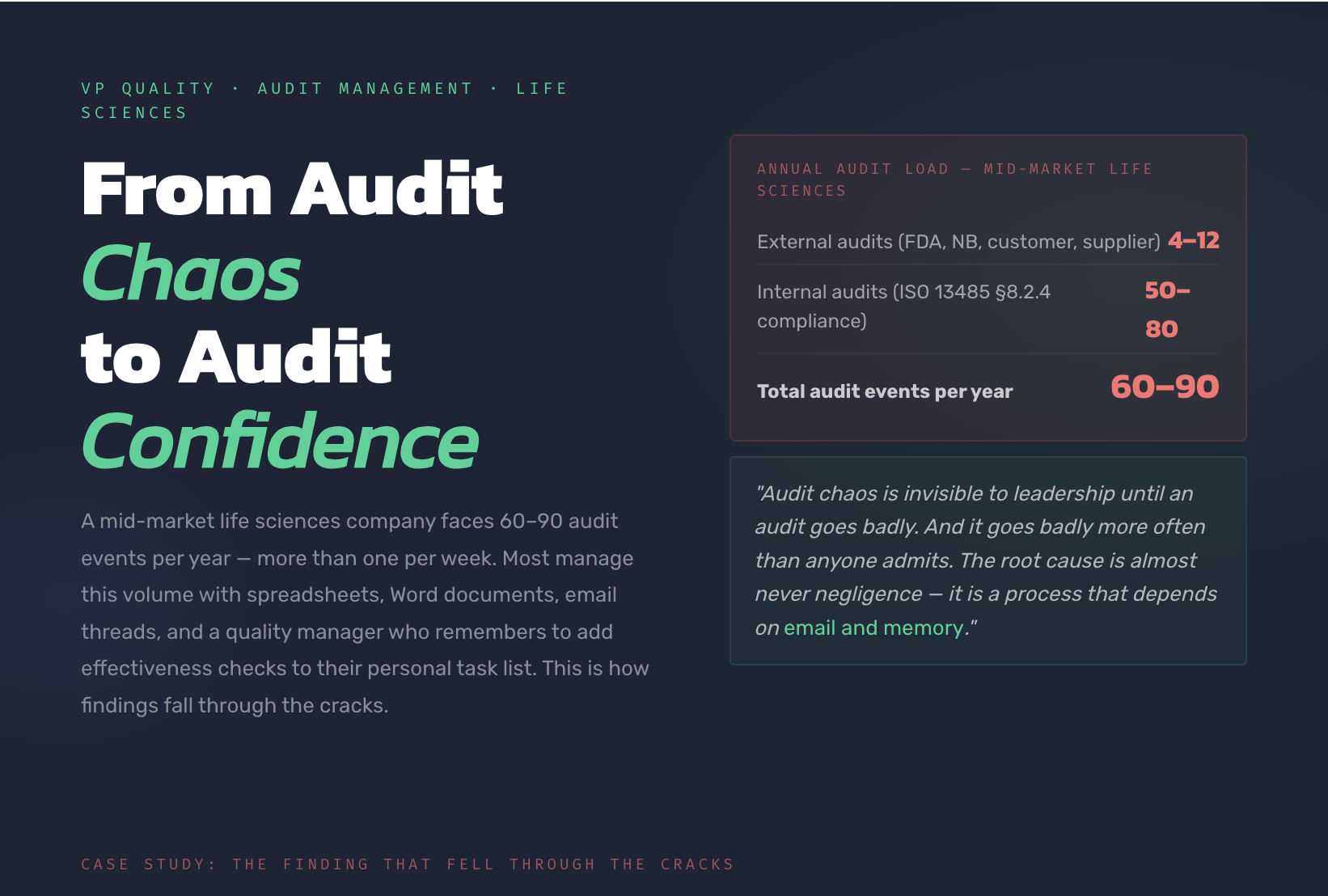
A mid-market life sciences company faces 4 to 12 external audits per year. FDA inspections, EU notified body audits, ISO 13485 surveillance audits, customer audits, and supplier audits create a relentless cycle of preparation, execution, response, and follow-up.
Internally, the quality system generates additional audit demand: internal audits required by ISO 13485 Section 8.2.4, process audits, supplier audits, and for-cause audits triggered by quality events. A company with 10 manufacturing processes, 150 suppliers, and a three-year internal audit cycle generates 50 to 80 internal audits per year.
Combined, that is 60 to 90 audit events per year — more than one per week.
Now consider how most companies manage this volume. The audit schedule lives in a spreadsheet or a calendar. Audit reports are Word documents stored in a shared drive. Findings are tracked in a separate spreadsheet — or worse, in the body of email threads. CAPA linkages are maintained manually. Effectiveness checks are scheduled by the quality manager who remembers to add them to their personal task list.
This is audit chaos. It is invisible to leadership until an audit goes badly. And it goes badly more often than anyone admits.
to Audit
Confidence

The Software Audit Survival Guide: A Practical Reference Guide to Level the Software Audit Playing Field
As an affiliate, we earn on qualifying purchases.
As an affiliate, we earn on qualifying purchases.
The Finding That Fell Through the Cracks
The anatomy of an audit management failure is predictable. During a notified body audit in March, the auditor identifies a minor nonconformity related to the calibration of a specific measurement instrument. The finding is documented in the audit report. The quality engineer responsible for calibration receives the report by email and acknowledges the finding.
Six months later, the same notified body returns for a follow-up audit. The auditor asks for evidence that the calibration finding has been resolved. The quality engineer who received the original finding has moved to a different role. The email thread is buried. No CAPA was opened. No corrective action was taken.
The minor nonconformity is now a major nonconformity — escalated because the company failed to respond to a finding. The major nonconformity triggers a 90-day corrective action deadline and increased audit frequency. The cost: $75,000 in remediation effort and $30,000 per year in additional audit fees from the increased surveillance frequency.
This scenario costs the company $105,000 in the first year and $30,000 per year thereafter. The root cause was not negligence — it was an audit management process that depended on email and memory.

Integrating Program Management and Systems Engineering: Methods, Tools, and Organizational Systems for Improving Performance
As an affiliate, we earn on qualifying purchases.
As an affiliate, we earn on qualifying purchases.
What Structured Audit Management Changes
Structured audit management replaces ad hoc processes with a systematic framework where every audit is planned, every finding is captured, every response is tracked, and every effectiveness check is verified.
QAtrial’s audit management module provides this framework with four interconnected capabilities.
Audit Planning and Scheduling
Every audit — internal and external — is scheduled in the system with defined scope, audit team, auditee, and planned dates. The audit schedule is generated from a risk-based annual plan that considers process risk, previous finding history, and regulatory requirements.
Internal audits are scheduled to ensure complete quality system coverage over the audit cycle period. QAtrial tracks which processes, departments, and ISO 13485 clauses have been audited and identifies gaps in coverage before they become audit findings themselves. Auditors cannot claim their organization failed to conduct a comprehensive internal audit program when the system provides evidence of systematic coverage.
External audits — inspections, notified body visits, customer audits — are logged as they are scheduled, with preparation tasks automatically assigned to responsible parties. The system generates an audit preparation checklist based on the audit scope, previous findings, and any open CAPAs related to the audit area.
Finding Capture and Classification
During the audit, findings are captured directly in QAtrial with structured data fields: finding type (observation, minor nonconformity, major nonconformity, critical finding), clause or regulation reference, description, objective evidence, and root cause category.
This classification structure is not bureaucratic overhead — it is the foundation of meaningful audit analytics. When findings are classified consistently, the quality organization can identify systemic patterns. Are calibration findings recurring across multiple audits? Are training findings concentrated in a specific department? Is the supplier audit program generating the same finding type repeatedly?
Without structured classification, these patterns are invisible. The quality team responds to individual findings without recognizing the systemic issues that generate them.
QAtrial’s finding classification uses a standardized taxonomy that maps to ISO 13485 clause structure, FDA quality system regulation sections, and EU MDR requirements. This enables cross-audit analysis regardless of whether the finding originated from an internal audit, a notified body visit, or an FDA inspection.
CAPA Linkage and Response Tracking
Every finding that requires corrective action is linked to a CAPA record in QAtrial’s CAPA management module. This linkage is not optional — the system enforces it for any finding classified as a nonconformity.
The CAPA record captures root cause analysis, corrective action plan, responsible parties, target completion dates, and effectiveness check criteria. The audit finding and the CAPA share a bidirectional link: the finding record shows its linked CAPA and status, and the CAPA record shows its originating audit finding.
This eliminates the most dangerous gap in manual audit management: the finding that was acknowledged but never acted upon. In QAtrial, an unlinked nonconformity is flagged as an overdue action item that escalates automatically through the management chain.
Response tracking includes evidence collection. When the corrective action is complete, the responsible party uploads objective evidence — revised documents, retraining records, process data, photographs — directly to the CAPA record. The auditor reviewing the response has everything needed to evaluate effectiveness in a single location.
Effectiveness Verification
CAPA closure without effectiveness verification is a common audit finding in its own right. Auditors expect to see evidence that the corrective action actually prevented recurrence of the finding — not just that the action was completed.
QAtrial schedules effectiveness checks automatically based on the CAPA’s risk classification. High-risk CAPAs receive 30-day, 90-day, and 180-day effectiveness checks. Medium-risk CAPAs receive 90-day checks. The system assigns the check, sends reminders, and tracks completion.
If an effectiveness check reveals that the corrective action was not effective, the system triggers a new CAPA iteration. This closed-loop approach ensures that findings are not just addressed but resolved.
![MixPad Free Multitrack Recording Studio and Music Mixing Software [Download]](https://m.media-amazon.com/images/I/71ltIxIuz1L._SL500_.jpg)
MixPad Free Multitrack Recording Studio and Music Mixing Software [Download]
- Multitrack Recording and Mixing: Create mixes with audio, music, and voice tracks
- Track Customization: Apply effects and editing tools to tracks
- Music Creation Tools: Includes Beat Maker and MIDI Creator
As an affiliate, we earn on qualifying purchases.
As an affiliate, we earn on qualifying purchases.
The Economics of Audit Management
The financial case for structured audit management is built on four cost categories.
Finding Remediation Costs
Each audit finding requires investigation and response. A minor nonconformity typically consumes 40 to 80 person-hours. A major nonconformity consumes 100 to 300 person-hours. A critical finding or an FDA Form 483 observation can consume 200 to 500 person-hours.
At $100 per hour for quality professional time, a company with 20 findings per year spends $80,000 to $300,000 on finding remediation alone. Structured audit management reduces finding recurrence by 30 to 50 percent through systematic root cause analysis and effectiveness verification, saving $25,000 to $150,000 annually.
Audit Preparation Costs
Preparing for an external audit typically consumes 80 to 200 person-hours for a mid-market company. Much of this time is spent locating records, compiling evidence, and verifying that previous findings have been closed.
With structured audit management, preparation time decreases by 40 to 60 percent because the evidence is already organized, CAPA closures are documented, and the system generates readiness reports automatically. For a company facing 8 external audits per year, that is 250 to 500 person-hours saved — $25,000 to $50,000 annually.
Escalation and Re-Audit Costs
Unresolved findings lead to escalation — increased audit frequency, certificate suspension risk, or regulatory action. Each escalation event costs $20,000 to $100,000 in additional audit fees, expedited remediation, and management attention.
A company that eliminates escalation events through timely finding response saves $40,000 to $200,000 per avoided escalation.
Management Review Time
Quality leadership spends significant time on audit-related activities: reviewing finding status, approving CAPA plans, reporting to executive management, and communicating with auditors. With structured audit management, this time is reduced by providing real-time dashboards that eliminate the need for manual status compilation.
QAtrial’s audit dashboard shows open findings by classification and age, CAPA completion rates, effectiveness check results, and audit schedule adherence. Management review preparation that previously consumed a full day can be completed in 30 minutes.

AI-Powered Contract Management: AI-Powered Contract Management:AI contract management, legal automation, contract lifecycle management, AI legal tech, … compliance monitoring, smart contracts.
As an affiliate, we earn on qualifying purchases.
As an affiliate, we earn on qualifying purchases.
Audit Analytics: From Reactive to Predictive
The most valuable long-term benefit of structured audit management is the analytical capability it creates. When three years of audit findings are captured in a structured database with consistent classification, the quality organization can identify systemic trends that are invisible in document-based systems.
Repeat finding analysis identifies finding categories that recur despite corrective actions — indicating that root cause analysis is not reaching the true root cause. Department hot spot analysis identifies organizational units that generate disproportionate findings — indicating systemic issues with resources, training, or management attention. Clause trend analysis identifies quality system elements that are consistently weak — informing strategic quality improvement priorities.
QAtrial provides these analytics through built-in reporting that aggregates finding data across audits, time periods, and classification categories. The VP Quality team does not need a data analyst to extract insights — the system presents them as part of the standard audit management workflow.
Regulatory Expectations
ISO 13485:2016 Section 8.2.4 requires an internal audit program that considers the status and importance of processes and areas to be audited, as well as the results of previous audits. FDA’s Quality System Inspection Technique (QSIT) guide specifically evaluates the adequacy of CAPA processes linked to audit findings. EU MDR Article 10(9) requires manufacturers to establish and keep up to date a systematic procedure for post-market surveillance, which includes management of audit findings.
These requirements converge on a single expectation: audit management must be systematic, documented, and demonstrably effective. A spreadsheet and email thread cannot meet this standard at scale.
The VP Quality’s Path Forward
If your audit management process requires you to search through email threads to find the status of a six-month-old finding, your process is failing. If your CAPA completion rate for audit findings is below 90 percent, your process is failing. If you cannot tell your CEO, in real time, how many open audit findings exist and when they will be closed, your process is failing.
QAtrial’s audit management module provides the structure, automation, and analytics that transform audit management from a source of anxiety into a source of confidence. It is available today — open source, self-hosted, and integrated with CAPA management, document control, and training management.
Your auditors are coming. Be ready.
Deploy structured audit management with QAtrial at github.com/MeyerThorsten/QAtrial. Track every finding. Close every loop.