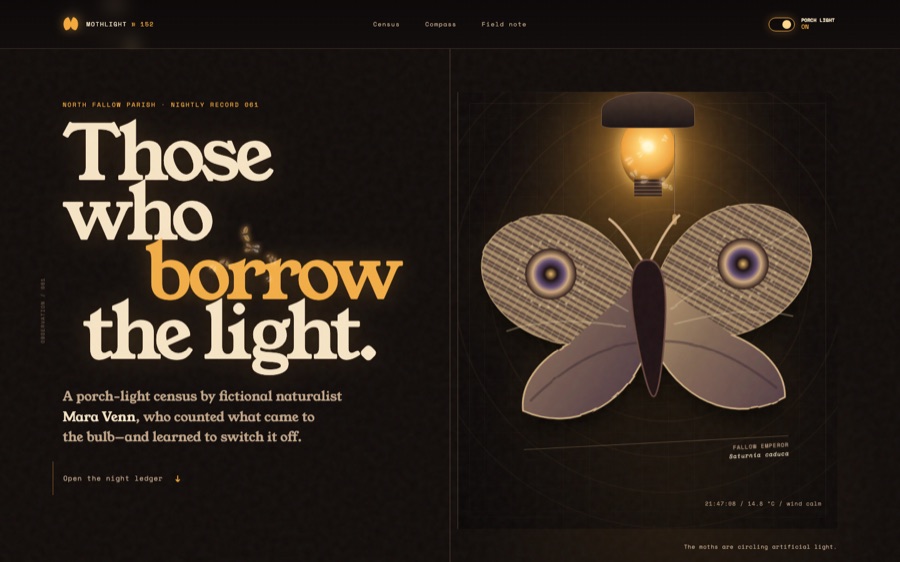
What if the most important part of a light fixture were not its glow, but the quiet chain of choices that makes it visible to a moth? “Mothlight — A Porch-Light Census” turns that question into a field guide, tracing how small encounters with borrowed light can become a system worth studying.

Get business pricing on monitors, keyboards and dev gear
- Business-only prices and quantity discounts
- Tax-exempt purchasing
- Multiple users, one account, clear invoices
For software, QA, and development readers, the intrigue is in the method: semantic light attractors. Rather than treating light as decoration, the project gives it a role—one that can be examined, named, and tested against what happens in the field. The result is a design case study built around observation and constraints, not spectacle.
There are no photographs and no generated assets. That absence shifts attention toward the making of Site 152: the choices behind the experience, the signals it uses, and the careful boundary between documenting a living world and simulating one. It’s an invitation to think about interfaces as environments—and about what a system may draw in simply by being present.
The field guide opens with a deceptively simple question: when a porch light becomes an attractor, what exactly is being counted?
Read the full design teardown → · Visit the live room
As an affiliate, we earn on qualifying purchases.
As an affiliate, we earn on qualifying purchases.
eco-friendly outdoor porch lighting
As an affiliate, we earn on qualifying purchases.
As an affiliate, we earn on qualifying purchases.
As an affiliate, we earn on qualifying purchases.
Halloween Picks
halloween
As an affiliate, we earn on qualifying purchases.