Audit preparation at regulated companies follows a familiar pattern. Two weeks before the auditor arrives, the quality team enters crisis mode. Binders are assembled. Traceability matrices are rebuilt in Excel. Evidence files are hunted across shared drives, email attachments, and individual laptops. Consultants are engaged at $250-400 per hour to fill gaps. The process consumes hundreds of staff hours, costs tens of thousands of dollars, and still leaves the team uncertain about whether everything is accounted for.

Get monitors, keyboards and dev gear delivered free — and shop member deals
- Fast, free delivery on millions of items
- Access to Prime Big Deal Days deals on October 6–7
- Prime Video, Amazon Music and more included
This article examines how QAtrial v3.0.0 eliminates the audit preparation scramble by making compliance evidence a byproduct of daily quality work rather than a retroactive assembly project.
Weeks to Hours
Consultant fees: $25,000–$50,000
×2 audits/year = $93,500+
The True Cost of Audit Preparation
A 2024 survey by the Regulatory Affairs Professionals Society found that mid-size pharmaceutical companies spend an average of 320 staff-hours preparing for a single FDA inspection. For medical device companies facing Notified Body audits under EU MDR, the figure is similar. These hours are not spent improving quality — they are spent proving that quality work already happened.
The breakdown is predictable:
- Traceability reconstruction (60-80 hours): Mapping requirements to tests to evidence to approvals, typically across disconnected spreadsheets.
- Evidence collection (40-60 hours): Locating test results, deviation reports, training records, and change control documentation.
- Audit trail assembly (30-50 hours): Recreating a chronological record of who did what, when, and why.
- Gap remediation (80-120 hours): Discovering missing signatures, incomplete CAPA closures, and untested requirements — then rushing to close them.
- Consultant fees ($15,000-50,000): External expertise to review readiness and coach the team through the audit.
The total cost of a single audit cycle easily reaches $100,000+ when staff time and consultant fees are combined. For companies facing multiple audits per year across different regulatory frameworks, the annual burden is substantial.
As an affiliate, we earn on qualifying purchases.
What QAtrial Automates
QAtrial does not add a “generate audit report” button on top of disconnected data. Instead, it structures daily quality work so that audit evidence accumulates automatically.
Traceability Matrix: Always Current
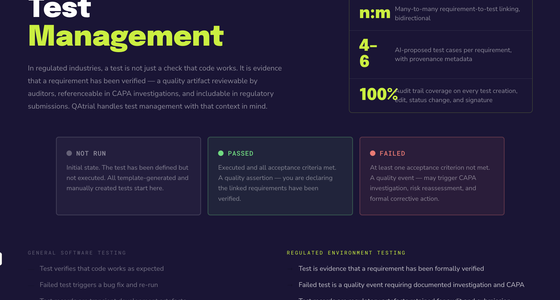
Every requirement in QAtrial is linked to its test cases, and every test case records its execution status. The traceability matrix is not a document someone builds before an audit — it is a live view that reflects the current state of every linkage. When a test is executed and passes, the traceability matrix updates. When a requirement changes, the linked tests are flagged for re-execution.
The server-side readiness endpoint (/api/dashboard/:projectId/readiness) computes a weighted compliance score across all requirements, tests, evidence, and approvals. This score is available at any moment, not just during audit prep.
Audit Trail: Append-Only, Always Complete
QAtrial’s audit trail is not a feature that can be turned on or off. Every create, update, delete, approval, signature, and status change is logged to an append-only PostgreSQL table with the user’s identity, timestamp, action type, previous value, new value, and reason. The system captures 16 distinct action types.
The audit trail is exportable as CSV at any time. There is no reconstruction step because there is nothing to reconstruct.
Evidence Management: Attached at the Source
Evidence files — screenshots, test results, validation protocols, calibration certificates — are attached directly to requirements, tests, and CAPA records. The missing-evidence dashboard endpoint (/api/dashboard/:projectId/missing-evidence) identifies requirements and tests that lack evidence attachments, making gaps visible in real time rather than two weeks before an audit.
Compliance Scoring: Gap Analysis on Demand
The AI-powered gap analysis compares a project’s current state against regulatory standards and identifies covered, partially covered, and missing clauses. For medical device companies, the QMSR gap analysis evaluates alignment with ISO 13485’s 27 clauses. For pharmaceutical companies, the GMP gap analysis covers 21 CFR 210/211 requirements.
This is not a one-time assessment. It can be run at any point in the project lifecycle, providing a continuous view of regulatory alignment.
quality management system for compliance
As an affiliate, we earn on qualifying purchases.
As an affiliate, we earn on qualifying purchases.
Audit Mode: The Auditor Gets a Link, Not a Binder
QAtrial’s Audit Mode represents a fundamental shift in how audit evidence is shared. Instead of assembling physical or digital binders, the quality team generates a time-limited, read-only shareable link.
The process takes less than 30 seconds:
- An administrator clicks “Share Audit Link” in the header.
- Selects an expiry period: 24 hours, 72 hours, or 7 days.
- Copies the generated URL and sends it to the auditor.
The auditor opens the link in any browser — no login required, no account creation, no VPN. They see a seven-tab read-only view:
- Overview: Project metadata, coverage metrics, status charts, compliance score.
- Requirements: Full requirements table with status, risk level, regulatory references, and tags.
- Tests: Test cases with execution status and linked requirements.
- Traceability: Complete requirement-to-test mapping with coverage indicators.
- Evidence: All attached evidence files, organized by parent record.
- Audit Trail: Chronological log of every action taken in the project.
- Signatures: Electronic signature records with signer identity, role, meaning, and timestamp.
The link expires automatically. An amber banner displays a countdown timer so the auditor knows exactly how long access remains. Print and Download Report buttons allow the auditor to capture what they need during the access window.
document management system for regulated industries
As an affiliate, we earn on qualifying purchases.
As an affiliate, we earn on qualifying purchases.
One-Click Export
For auditors who prefer traditional document packages, QAtrial supports CSV export of requirements, tests, and combined data sets. The Validation Summary Report (VSR) generates a seven-section audit-ready document. The Regulatory Submission Package formats output per authority — FDA 510(k), EU MDR, or PMDA STED.
All exports include UTF-8 BOM encoding for correct handling of international characters in Excel.
As an affiliate, we earn on qualifying purchases.
ROI Calculation
Consider a medical device company with 500 requirements, 1,200 test cases, and two major audits per year (one Notified Body, one internal).
Manual preparation (current state):
- Traceability reconstruction: 80 hours x $75/hr = $6,000
- Evidence collection: 60 hours x $75/hr = $4,500
- Audit trail assembly: 50 hours x $75/hr = $3,750
- Gap remediation: 100 hours x $75/hr = $7,500
- Consultant support: $25,000
- Total per audit: $46,750
- Annual cost (2 audits): $93,500
QAtrial-assisted preparation:
- Traceability: zero hours (always current)
- Evidence: zero hours (attached at source, gaps visible in dashboard)
- Audit trail: zero hours (append-only, always complete)
- Gap remediation: 20 hours x $75/hr = $1,500 (gaps found early, remediated incrementally)
- Consultant support: $5,000 (review only, no assembly)
- Audit link generation: 5 minutes
- Total per audit: $6,500
- Annual cost (2 audits): $13,000
Annual savings: $80,500. And this does not account for the reduction in audit findings, the elimination of repeat observations, or the value of staff hours redirected from audit prep to actual quality improvement.
The Tool Validates Itself
A common challenge with quality management software is the circular dependency: you need a validated system to manage validation, but validating the system requires the same kind of evidence the system is supposed to manage.
QAtrial ships with its own IQ/OQ/PQ validation package. The Installation Qualification protocol includes 9 test steps. The Operational Qualification covers 18 test steps spanning every core workflow. The Performance Qualification provides a customer-fillable template. The Compliance Statement maps QAtrial’s features against 21 CFR Part 11 (15 sections), EU Annex 11 (17 sections), and GAMP 5 Category 4. The Traceability Matrix links 75 regulatory requirements to specific features and test IDs.
This means the first audit question — “Is your quality management system validated?” — is answered before the system goes live.
Conclusion
Audit readiness should not be an event. It should be a state. QAtrial achieves this by embedding traceability, evidence management, audit trail, and compliance scoring into the daily workflow. When the auditor arrives, the evidence is already there. The only preparation needed is generating a link.
QAtrial is developed privately and is not publicly available.
Fall Picks
fall essentials
As an affiliate, we earn on qualifying purchases.