

Among these 12 automated API testing resources, The Complete API Testing Handbook is my best overall pick for its focus on REST validation, automation, and security with Python. FastAPI Testing with Pytest and HTTPX is a sharper choice for developers testing Python services, while API Testing and Development with Postman suits readers who want a tool-led introduction. The main tradeoff is breadth versus a focused workflow: some titles cover API testing directly, while others teach wider QA or web automation skills. These are books and practical guides rather than standalone testing platforms, so check that each matches your preferred tools and experience level. Read on for the full comparison and help choosing the right learning path.

Get monitors, keyboards and dev gear delivered free — and shop member deals
- Fast, free delivery on millions of items
- Access to Prime Big Deal Days deals on October 6–7
- Prime Video, Amazon Music and more included
Key Takeaways
- The Complete API Testing Handbook has the broadest direct API remit in this lineup, bringing REST validation, automation, and security testing together with Python.
- FastAPI Testing with Pytest and HTTPX is the most targeted choice for Python teams working with FastAPI; its focus makes it less suited to readers seeking a general API testing guide.
- Postman appears in two titles, but the practical guide’s emphasis on creating, testing, and managing APIs gives it a more explicit workflow focus than the shorter Postman title.
- Playwright and TypeScript offer an API testing path inside a web automation ecosystem, while the Playwright web automation book has a wider browser testing emphasis.
- Several titles extend beyond direct API automation into general QA, AI, or specification-led testing; these may suit broader learning goals but are less direct starting points for API-only work.




More Details on Our Top Picks
API Testing and Development with Postman
Postman workflow coverage gives this book a focused role for developers who want to connect API creation with testing and debugging. Its practical examples are meant to help readers make routine API checks part of their development process, rather than treating testing as a separate handoff. Compared with Testing Web APIs, which has little description available here, this title has a clearer tool-specific focus. It is broader than the FastAPI-specific guide in this list, but that breadth comes with a tradeoff: the supplied details say it offers limited depth on advanced API management, and they do not identify particular automation features or workflows. I’d choose it for a Postman-centered introduction to API work, while readers seeking framework-specific test code should look to the Pytest and HTTPX guide.
Pros:- Connects API development, testing, and debugging in a single Postman-focused guide
- Practical examples can help readers apply concepts to routine API work
- A tool-specific scope makes it more directly relevant to Postman users than the broad QA career guide
Cons:- The supplied description indicates limited detail on advanced API management
- No specific automated test features or technical workflows are identified in the product data
Best for: Developers who want practical Postman guidance for creating, testing, and debugging APIs in one workflow
Not ideal for: API platform leads seeking detailed advanced management guidance or readers who need documented, framework-specific automation techniques
- Format:Book
- Primary tool:Postman
- Main focus:API testing and development
- Covered activities:Creating, testing, debugging, and managing APIs
- Example style:Practical examples using Postman
- Intended audience:Developers of all skill levels
Our verdict“Choose this book for practical Postman-centered API workflow guidance; pick the FastAPI guide for code-level testing with Pytest and HTTPX.”
Testing Web APIs
Testing Web APIs is the most plainly titled option here, but the supplied product data gives no description of its methods, tools, audience, or automation coverage. That makes it hard to rank as a practical choice for someone specifically comparing automated API testing tools. In contrast, API Testing and Development with Postman names a tool and describes hands-on workflow topics, while the FastAPI guide lists Pytest, HTTPX, and several test types. This book may still suit a reader who wants to investigate a dedicated API-testing text, but I can’t infer whether it covers scripting, CI, or a particular protocol from its title alone. The main tradeoff is uncertainty: the narrow subject is apparent, but the fit for automation work is not established by the available details.
Pros:- Title directly signals a focus on web API testing
- A dedicated subject may appeal to readers looking for an API-centered resource
- Its scope can be compared against the more tool-specific Postman and FastAPI guides
Cons:- No product description is available to confirm its methods or intended audience
- No automation tools, examples, or API test types are identified in the supplied data
- Readers cannot determine from the available details whether it covers current workflows such as CI
Best for: Readers willing to inspect the book’s contents before purchase who want a title centered on web API testing
Not ideal for: QA engineers who need confirmed automation tools, coding examples, or coverage of CI workflows before choosing a guide
- Format:Book
- Subject:Testing web APIs
- Product identifier:ASIN 1617299537
- Named tools:Not specified in supplied product data
- Testing methods:Not specified in supplied product data
- Intended audience:Not specified in supplied product data
Our verdict“Consider it only if you can verify its contents first; the Postman and FastAPI titles provide clearer evidence of their automation focus.”
All You Need to Know About Software Testing: From Beginner to Job-Ready QA Engineer
Broad QA preparation is this book’s defining strength: its stated coverage spans manual testing, automation, APIs, browser tools, CI/CD, and AI-assisted QA. That makes it a wider career-oriented resource than API Testing and Development with Postman, which concentrates on one API tool and workflow. For readers focused on automated API testing, the benefit is context: API checks sit alongside the wider test process and delivery pipeline. The tradeoff is focus. The description does not name specific API-testing techniques or tools, so readers looking to build a concrete API suite may get less targeted guidance than from FastAPI Testing with Pytest and HTTPX. I’d use this as a foundation for aspiring QA engineers, then choose a specialist guide for implementation details.
Pros:- Covers API testing within a wider software QA curriculum
- Includes automation and CI/CD topics that connect testing with delivery workflows
- AI-assisted QA and browser automation broaden its usefulness for career preparation
Cons:- The supplied description does not identify specific API automation tools or techniques
- Wide coverage may leave less room for detailed API test implementation than a specialist guide
Best for: Aspiring QA engineers who need a broad learning path that includes API automation alongside manual testing and CI/CD
Not ideal for: Experienced API automation engineers seeking detailed, tool-specific examples for building or maintaining API test suites
- Format:Book
- Primary audience:Aspiring QA engineers
- Testing coverage:Manual testing and automation
- API coverage:API testing
- Browser automation tools:Selenium and Playwright
- Delivery topics:CI/CD
- Additional topic:AI-assisted QA
Our verdict“Choose this for broad QA career preparation that includes APIs, and pair it with a specialist guide when you need hands-on API automation detail.”
API Testing and Development with Postman: A Practical Guide to Creating, Testing, and Managing APIs for Automated Software Testing
Practical Postman guidance is the clearest reason to choose this title: its description links API creation, testing, and management to automated software testing. That framing makes it a closer match for readers building a Postman-based workflow than the broader QA survey, All You Need to Know About Software Testing. It also overlaps with the other Postman book in this roundup, but the stated emphasis on automation gives this edition a more direct fit for test-focused readers. The tradeoff is that the supplied details do not list specific Postman features, code examples, or supported test workflows, so buyers cannot judge the technical depth from the summary. Since the description also flags potentially technical material, beginners may prefer a more introductory route before relying on it as their first testing resource.
Pros:- Explicitly connects Postman API testing with automated software testing
- Covers creating, testing, and managing APIs in one practical guide
- The description identifies developers and testers as useful audiences
Cons:- No specific Postman automation features or test examples are detailed in the supplied data
- The technical content may be challenging for readers new to APIs
Best for: Developers and testers who want a practical Postman-centered guide tied directly to automated software testing
Not ideal for: Readers seeking a confirmed beginner-friendly introduction or detailed specifications of Postman automation capabilities
- Format:Book
- Primary tool:Postman
- Main focus:API testing and development
- Automation focus:Automated software testing
- Covered activities:Creating, testing, and managing APIs
- Intended audience:Developers and testers
Our verdict“Pick this Postman guide for a practical automation-oriented framing, while beginners may find the broader QA book easier to approach.”
FastAPI Testing with Pytest and HTTPX: A Practical Guide
Framework-specific test construction sets this guide apart: it names FastAPI, Pytest, and HTTPX, and covers unit, API, database, and authentication testing alongside mocking. That gives Python developers a more concrete implementation path than either Postman book, which centers on a separate API client workflow. The emphasis on production-ready test suites also points toward maintainable coverage, not just isolated request checks. Its specialization is the main tradeoff. Readers working across varied API stacks or seeking a general introduction to automated API testing may find the FastAPI scope too narrow, while the supplied description does not spell out deployment or CI coverage. For teams building FastAPI services, though, the named tools and test areas make this the most technically specific choice in this batch.
Pros:- Names a concrete stack: FastAPI, Pytest, and HTTPX
- Covers API, unit, database, and authentication testing
- Includes mocking and guidance toward production-ready test suites
Cons:- Its FastAPI focus limits direct use for teams working with other frameworks
- The supplied description does not specify CI integration or deployment workflows
Best for: Python developers and QA engineers testing FastAPI services who need coverage for API, database, and authentication behavior
Not ideal for: Teams using other API frameworks or readers who need a cross-platform overview of API testing tools
- Format:Book
- Framework:FastAPI
- Test framework:Pytest
- HTTP client:HTTPX
- Testing topics:Unit, API, database, and authentication testing
- Additional technique:Mocking
- Suite focus:Production-ready test suites
Our verdict“Choose this for hands-on testing of FastAPI applications; use a Postman guide if your workflow centers on a cross-stack API client.”
The Complete API Testing Handbook: A Practical Guide to REST API Validation, Automation, and Security Testing with Python
This handbook is the most focused pick here for readers who want to build Python-based REST API checks that reach beyond basic response validation. Its stated coverage combines validation, automation, and security testing, giving it a broader API-specific scope than API Testing for Beginners: Using Postman and Rest Assured, which spans two different tools and also targets interview preparation. The step-by-step format may suit developers who want a guided route from checks to automated workflows. The tradeoff is that the listed material centers on Python and REST; buyers seeking a Postman-first introduction or coverage of Playwright and TypeScript should look to the other books in this batch. The available description does not name particular Python libraries or frameworks, so readers needing a guide to a specific stack may want more detail before choosing it.
Pros:- Covers REST API validation, automation, and security testing
- Uses Python throughout its stated subject scope
- Step-by-step approach can help readers build skills in sequence
- Focuses directly on API testing rather than general web automation
Cons:- The described scope is centered on REST APIs and Python
- No specific Python libraries or testing frameworks are identified in the supplied details
- Book format provides instruction rather than an executable testing tool
Best for: Developers learning to automate REST API validation and security checks with Python.
Not ideal for: Readers focused on Postman, Rest Assured, or Playwright and TypeScript, since those tools are not listed as part of this book.
- Format:Book
- Series:Hands-On Tech Professional Series
- Series number:4
- Programming language:Python
- API style:REST
- Topics:API validation, automation, and security testing
Our verdict“Choose this handbook if you want a guided Python path through REST API validation, automation, and security testing.”
API Testing for Beginners: Using Postman and Rest Assured
This book pairs Postman and Rest Assured, making it a useful starting point for learners deciding whether to test APIs through a GUI-led workflow, code-based automation, or both. Its description also calls out framework development, practice questions, and interview preparation, so it speaks to aspiring testers building both practical and career skills. Compared with The Complete API Testing Handbook, it is less tied to a single language-focused path; the handbook instead has a clearer Python and security-testing emphasis. That breadth can help beginners survey the landscape, though the available details do not spell out the languages, versions, or exact exercises covered. Readers who already know their preferred stack may get more focused guidance from the Playwright and TypeScript book in this batch.
Pros:- Introduces both Postman and Rest Assured
- Covers automation and framework development
- Includes practice questions and interview preparation
- Aims at beginners while also describing advanced testing techniques
Cons:- The supplied details do not identify programming languages or tool versions
- The breadth across tools and career preparation may be less focused than a single-stack guide
Best for: New QA testers who want an introduction to Postman and Rest Assured alongside practice and interview preparation.
Not ideal for: Experienced engineers seeking detailed, version-specific guidance for one established API testing stack.
- Format:Book
- API testing tools:Postman and Rest Assured
- Topics:API testing and automation
- Framework coverage:Framework development
- Learning materials:Practice questions
- Career preparation:Interview preparation
Our verdict“Pick this book if you are starting out and want tool exposure plus interview practice in one API testing guide.”
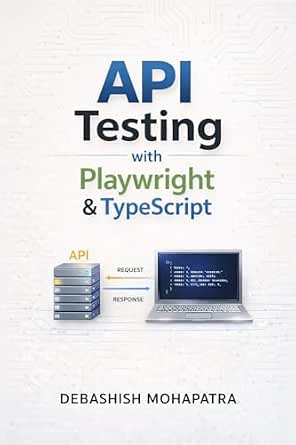
API Testing with Playwright & TypeScript: A Practical Guide from Zero to Expert
For readers whose projects already use Playwright and TypeScript, this guide offers a direct route to API test automation within that toolchain. That focus distinguishes it from API Testing for Beginners: Using Postman and Rest Assured, which introduces a wider pair of tools and includes interview preparation. The Playwright book is presented as suitable for both beginners and experienced testers, with practical techniques aimed at building API testing skills; that makes it a better match for teams seeking continuity with a TypeScript codebase than for people comparing API platforms. The supplied description does not identify particular libraries, sample projects, or TypeScript prerequisites beyond a note that some basic knowledge may be needed. Beginners should be ready to fill in those foundations as they go.
Pros:- Focuses on API testing with Playwright and TypeScript
- Describes practical techniques and examples
- Intended for both beginner and experienced testers
- Fits readers already working in a TypeScript testing environment
Cons:- May require basic TypeScript and testing framework knowledge
- The supplied details do not identify specific frameworks, versions, or example projects
Best for: TypeScript developers and QA engineers who want to add API automation to a Playwright-based testing workflow.
Not ideal for: Readers who need a no-code introduction, a Postman-centered approach, or detailed information about prerequisites before buying.
- Format:Book
- API testing tool:Playwright
- Programming language:TypeScript
- Topic:API testing
- Approach:Practical guide
- Audience:Beginners and experienced testers
Our verdict“Choose this guide if your API tests need to fit naturally into a Playwright and TypeScript workflow.”
Web Automation Testing Using Playwright
This book places API checks within a wider Playwright web automation toolkit, also covering end-to-end, accessibility, and visual testing. That makes it a broader choice than API Testing with Playwright & TypeScript, whose stated scope centers on API testing and TypeScript. If you need one learning resource to connect API checks with browser journeys and interface quality, the wider remit may help you see where each layer fits. The tradeoff is less apparent API specialization: the description does not say how deeply it treats API automation, nor does it name a programming language, examples, or framework setup. Readers whose main goal is focused REST validation or security testing may prefer The Complete API Testing Handbook instead.
Pros:- Covers API testing alongside end-to-end web testing
- Includes accessibility testing
- Includes visual testing
- Uses Playwright as a common thread across testing areas
Cons:- API testing is one part of a wider web testing scope
- The supplied details do not specify a programming language or technical setup
- No particular API testing examples or security topics are identified
Best for: QA engineers who want to combine API checks with browser, accessibility, and visual testing in Playwright.
Not ideal for: Readers seeking a dedicated API automation curriculum or detailed language-specific setup guidance.
- Format:Book
- Tool:Playwright
- API testing:Covered
- End-to-end testing:Covered
- Accessibility testing:Covered
- Visual testing:Covered
Our verdict“Choose this book if you want API testing as part of a wider Playwright web quality workflow.”
AI Testing with Python: Build Intelligent Test Automation Using Python, Selenium, APIs, PyTest, LLMs, and AI-Powered Testing Tools
This guide is the most expansive automation pick in this group: it combines Python, PyTest, APIs, Selenium, LLMs, and AI-powered testing tools. That mix may appeal to engineers exploring how API checks fit into a broader intelligent test automation practice. Compared with The Complete API Testing Handbook, it gives less of an API-only signal and adds browser automation and AI topics; the handbook is the more focused choice for REST validation and security testing. The wide scope is both its draw and its tradeoff: readers may get a cross-tool perspective, but the supplied description does not indicate how much space API testing receives or which AI tools and techniques are covered. Buyers wanting a narrow API curriculum should favor a more specialized title.
Pros:- Connects API testing with Python and PyTest
- Also addresses Selenium-based automation
- Covers LLMs and AI-powered testing tools
- Targets intelligent test automation across several methods
Cons:- The broad scope may give API testing less depth than a dedicated API guide
- The supplied details do not name particular LLMs or AI testing tools
- No version or prerequisite information is provided
Best for: Python automation engineers exploring how API tests, PyTest, and AI-assisted methods can work alongside Selenium.
Not ideal for: Readers who want a narrowly focused API testing book or need named AI tools, specific examples, and framework versions.
- Format:Book
- Programming language:Python
- API testing:Covered
- Testing framework:PyTest
- Browser automation tool:Selenium
- AI topics:LLMs and AI-powered testing tools
Our verdict“Pick this guide if you want a broad Python automation resource that includes APIs and AI-assisted testing.”
Bruno API Testing for Beginners: Test REST APIs Step-by-Step (Without Postman)
Bruno-focused, step-by-step instruction gives new learners a route into REST API testing without requiring prior Postman experience. That makes this a distinct starting point alongside API Testing for Beginners: Using Postman and Rest Assured, which introduces different tools and workflows. The practical emphasis can help readers follow basic testing processes before taking on more advanced automation.
The tradeoff is depth: the available description notes limited technical examples and no advanced topics, so readers building a sophisticated automated test suite may outgrow it. Compared with FastAPI Testing with Pytest and HTTPX, this book is positioned for a more introductory audience rather than a specific programming stack. It fits learners who want a guided first step, but experienced testers should choose a resource with deeper technical coverage.
Pros:- Step-by-step approach suited to beginners
- Covers practical REST API testing techniques
- Does not require prior Postman experience
Cons:- Limited detail in technical examples
- Does not cover advanced testing topics
- May be too basic for experienced testers
Best for: New REST API learners who want step-by-step guidance and prefer to learn without Postman.
Not ideal for: Experienced testers or developers seeking detailed code examples, advanced automation, or in-depth technical coverage.
- Format:Book
- Subject:REST API testing
- Intended level:Beginner
- Instruction style:Step-by-step
- Tool emphasis:Bruno
- Postman required:No
Our verdict“Choose this as a guided introduction to REST API testing if you want a beginner-level path that does not depend on Postman.”
Spec-Driven Software Testing with AI: Build Reliable Test Suites from Specifications with AI, Test Automation, TDD, API Testing, and CI/CD
Specification-based test design is the defining angle here: the book connects AI-driven methods with test automation, TDD, API testing, and CI/CD. That broader workflow makes it a more ambitious choice than Bruno API Testing for Beginners, which focuses on introductory REST API testing. For teams trying to turn written requirements into repeatable test suites, the subject matter points toward a way to connect test intent with automated checks.
The breadth also brings a learning curve. The description flags the material as potentially too technical for beginners, and it does not provide product-specific details about languages, platforms, or sample projects. Compared with AI Testing with Python, this title centers specifications and suite design rather than a named Python toolkit. It is best suited to readers ready to work across testing and delivery practices.
Pros:- Connects AI-driven testing with specification-based test design
- Covers test automation, TDD, API testing, and CI/CD
- Focuses on building reliable test suites from specifications
Cons:- May be technically demanding for beginners
- Available product details do not identify a specific language or toolchain
Best for: QA engineers and developers who already understand testing basics and want to explore AI-assisted, specification-driven automation across API testing and CI/CD.
Not ideal for: First-time testers looking for a gentle introduction or readers who need a clearly specified programming language and toolchain.
- Format:Book
- Primary approach:Specification-based testing
- AI focus:AI-driven testing methods
- Test automation:Covered
- TDD:Covered
- API testing:Covered
- CI/CD integration:Covered
- Intended level:Potentially technical for beginners
Our verdict“Pick this if you have testing fundamentals and want a broader guide to building AI-assisted suites from specifications.”

How We Picked
I ranked these resources by how directly their stated scope serves someone learning or applying automated API testing. I gave more weight to titles that name API validation, automation, or security as central topics, then considered whether the tools and languages are clear enough for a buyer to judge fit before starting. A focused Python guide can be a stronger choice for a FastAPI team than a broader handbook, even if it covers fewer workflows.
I also considered learning path and scope tradeoffs: beginner orientation, practical tool coverage, and whether the material extends into browser automation, general QA, or AI-assisted testing. Titles focused mainly on broader software or web testing rank lower for API-specific intent, though they can be useful for readers with those adjacent goals. These rankings reflect the books’ stated topics and titles; they are not a claim that the books were independently tested or that they provide the testing tools themselves.
Factors to Consider When Choosing Automated API Testing Tools
Choose a learning resource by matching its workflow to the APIs you maintain and the skills you want to build. The title alone can be misleading: a book about testing may focus on general QA or browser automation rather than repeatable API checks.
Match the resource to your API stack
Start with the framework and language your team already uses, since examples are easier to adapt when they resemble your codebase. A Python guide built around Pytest and HTTPX will map more closely to a Python service than a Postman-centered workflow. For teams with several languages or a mixed backend, a tool-neutral testing process may matter more than framework-specific depth. Check whether the material targets REST APIs, since that focus may not cover GraphQL or event-driven interfaces in enough detail. A common mistake is choosing a popular tool first and then trying to force every service into its workflow. Pick the resource that helps you create checks your team can maintain after the tutorial ends.
Separate API checks from browser automation
API tests exercise requests and responses directly, while browser tests also involve page behavior, selectors, and user flows. Playwright can support both kinds of work, but a guide centered on web automation may spend little time on API-specific concerns such as schema validation or authentication. That breadth is useful when one team owns both browser and service checks. If your immediate goal is a reliable API suite, choose a resource that makes those checks a central topic. Avoid treating browser automation coverage as proof of deep API testing coverage. The right balance depends on whether you need shared tooling across layers or a focused service test strategy.
Check how much security and failure behavior it covers
A successful response is only one part of an API test plan. Buyers should look for coverage of invalid inputs, authorization boundaries, error responses, and sensitive data handling. Security testing in a title can signal broader scope, but the title alone does not tell you how detailed its exercises are. Before choosing, inspect the contents or sample pages for concrete treatment of authentication and negative cases. A common gap is building a suite that checks only the happy path, which can miss regressions that matter to clients. Pay for breadth when your work spans many endpoints or risk levels; choose a narrow guide when you need to get one framework’s basic checks in place.
Choose a learning level you can sustain
Beginner resources can lower the initial barrier, but they may move too slowly for an experienced developer who needs advanced fixtures or CI workflows. A title promising a path from beginner to job-ready QA may cover many subjects while giving less room to API automation itself. Look for prerequisites, chapter outlines, and code examples before committing to a learning sequence. If you are new to testing, prefer a resource that explains assertions and test design, not only tool setup. Experienced teams may get more value from focused material tied to their framework. The practical tradeoff is breadth for orientation versus depth for immediate implementation.
Decide whether AI or specification-led testing fits the problem
AI-assisted and specification-led testing can help teams generate cases from requirements, but these approaches depend on clear inputs and review by people who understand the system. They do not remove the need to decide what a valid response, security boundary, or regression looks like. A guide centered on AI may be a better fit for teams already exploring test generation than for someone seeking a first API test tutorial. Check that the workflow covers validating generated tests and keeping them aligned with changing specifications. Otherwise, automation can produce a larger suite that is hard to trust. Start with these approaches when your team has a clear source of truth and a plan for reviewing outputs.
Frequently Asked Questions
Which of these resources should I choose if I need an API testing tool, not a book?
These 12 items are books and practical learning guides, not standalone API testing software. They can help you learn workflows built around tools such as Postman, Pytest, HTTPX, Playwright, or Bruno, but they do not replace installing and evaluating those tools. If you need software for a team, compare the tool’s supported protocols, CI integration, collaboration model, and data handling separately. Use a book to learn a workflow, then confirm the software fits your team’s environment. The Postman and Bruno titles are especially tool-specific starting points.
Is a Postman guide or a Python testing guide a better first choice?
Choose Postman if you want to create and run API checks through a dedicated API client with less initial code setup. Choose a Python guide if your tests need to live alongside application code, use fixtures, or fit an existing Pytest pipeline. A tool-based start can make request construction easier to see, while code-based tests may offer more flexibility for complex setup and reusable assertions. Consider who will maintain the suite as well as who will write the first tests. If your team already standardizes on one approach, learning that workflow is usually more useful than starting from scratch with another.
Can a Playwright book teach enough API testing for a service team?
It can, if the guide gives API requests and response assertions sustained attention. The title matters: API Testing with Playwright & TypeScript is more directly aligned with that goal than a general web automation title. Playwright may suit teams that want API checks near browser tests, but that shared ecosystem can come with a wider learning surface. Review the outline for authentication, validation, test data, and service-level checks before deciding. If your team needs deep Python or REST testing coverage, a focused API handbook may be a closer match.
Should I pick an AI testing guide before I have a stable test suite?
Usually, first establish clear expected behavior and a way to run and maintain ordinary tests. AI-assisted methods are easier to judge when you can compare generated cases against known requirements and existing checks. The AI-focused titles in this roundup also extend into wider automation topics, so they may not serve as the most direct API testing introduction. They make more sense when your team has a defined use for generated tests or specification-driven workflows. Keep human review in the loop, especially for security and authorization cases.
What should I verify before buying a guide for a production API suite?
Check that the material covers the interface style, language, and test runner you plan to use, then inspect whether it treats authentication, error handling, and repeatable test data. Production suites also need a clear place in the build pipeline and a maintenance plan when endpoints change. A beginner book may explain request basics without addressing those operational needs, while a broad QA title may devote limited space to APIs. Chapter outlines and sample content can reveal this mismatch before you commit. For a team decision, compare the guide’s examples with one real service endpoint and one failure case from your own environment.
Conclusion
For the strongest direct API focus across validation, automation, and security, I recommend The Complete API Testing Handbook as best overall. For Python service teams, FastAPI Testing with Pytest and HTTPX is the best value in focused learning, while API Testing and Development with Postman: A Practical Guide is a practical choice for readers who want a guided Postman workflow. Beginners can start with API Testing for Beginners or the Postman guide; readers who want a compact, alternate client path can look at Bruno API Testing for Beginners. Choose the Playwright and TypeScript title for API checks alongside browser automation, and turn to the AI or specification-led titles when those methods are already part of your team’s plans.
Halloween Picks
halloween
As an affiliate, we earn on qualifying purchases.