Automated testing frameworks are the backbone of reliable software delivery, and the right book can shorten your learning curve by months instead of leaving you to piece together scattered tutorials. After comparing 14 titles, Hands-On Automated Testing with Playwright stands out as the best overall pick because it teaches a modern, actively maintained framework through practical, production-oriented examples. Two other standouts: Mastering Test Automation with the Robot Framework for teams who want a keyword-driven approach that non-programmers can contribute to, and AI Testing with Python for engineers preparing for the LLM-assisted testing workflows that are reshaping the field. The central tradeoff across this category is breadth versus depth — full-stack guides cover everything superficially, while framework-specific books go deep but lock you into one tool. Another recurring tension is beginner accessibility versus enterprise-scale practices like design patterns and CI/CD integration. Keep reading for the full breakdown, including which books to skip and which are worth every page.

Get monitors, keyboards and dev gear delivered free — and shop member deals
- Fast, free delivery on millions of items
- Access to Prime Big Deal Days deals on October 6–7
- Prime Video, Amazon Music and more included
Key Takeaways
- Playwright dominates this lineup — five of the 14 books center on it, and the best ones (Hands-On Automated Testing with Playwright and Web Automation Testing Using Playwright) win by covering API, accessibility, and visual testing alongside basic end-to-end flows.
- AI-powered testing has matured from a gimmick into a legitimate subcategory, but only two books (AI Testing with Python and Spec-Driven Software Testing with AI) treat it seriously — the rest of the field hasn’t caught up yet.
- Selenium titles split sharply by audience: Absolute Beginner (Part 1) is genuinely entry-level, while Ultimate Selenium WebDriver assumes Java proficiency and targets regulated industries — there is almost no middle ground.
- Several books with near-identical titles (the two Full Stack Testing guides, the two overlapping Playwright titles) differ meaningfully in currency and depth, so checking publication date and edition before buying matters more here than in most tech categories.
- Design Patterns for High-Quality Automated Tests is the only pick that is framework-agnostic, making it the longest-lived purchase in the roundup — its lessons survive framework migrations that would obsolete tool-specific books.




| automated testing framework | Format | Focus |
|---|---|---|
| Creating an End-to-End Test Fr | Kindle eBook | End-to-end framework design |
| Full Stack Testing: A Practica | Kindle eBook | Full-stack testing strategy and quality assurance |
| Mastering Test Automation with | Kindle eBook | Test automation best practices and techniques |
| Automated Testing Unleashed: A | Kindle eBook | Automated testing engineering fundamentals |
| Test-Driven Development with P | Print / digital book | — |
| AI Testing with Python: Build | Kindle / Paperback | AI-powered test automation |
| Design Patterns for High-Quali | Kindle / Paperback | Test design patterns and best practices |
| Playwright Automation Testing | Kindle / Paperback | — |
| Full Stack Testing: A Practica | Paperback / Kindle | Full-stack testing strategy and quality practices |
| Hands-On Automated Testing wit | Kindle / Paperback | — |
| Spec-Driven Software Testing w | Digital/Print book | — |
| Ultimate Selenium WebDriver fo | Print book | Framework design and implementation |
| Absolute Beginner | Digital book | Functional automation testing fundamentals |
| Web Automation Testing Using P | Print/digital book (English Edition) | — |
More Details on Our Top Picks
Creating an End-to-End Test Framework: A Practical Guide with Playwright, Cypress, and Cucumber
End-to-end framework building is exactly what most teams shopping in this space need, and this guide covers the three tools that dominate modern browser automation: Playwright, Cypress, and Cucumber. Where Automated Testing Engineering Fundamentals stops at theory, this book pushes into real-world implementation, which matters because readers choosing a framework usually want runnable patterns, not abstract principles. The multi-tool approach also means you can compare Playwright and Cypress side by side before committing your team to one. The tradeoff is depth: covering three frameworks in one volume means none gets exhaustive treatment, so teams already settled on a single tool may prefer the dedicated Hands-On Automated Testing with Playwright title instead. Beginners without coding fundamentals will also find the pacing steep.
Pros:- Covers three leading E2E tools in one place, enabling genuine framework comparison
- Practical, implementable examples rather than pure theory
- Includes BDD practices via Cucumber for teams using specification-driven workflows
- Focuses on framework architecture, which most tool-specific books skip
Cons:- Breadth over depth — each individual tool gets less coverage than a dedicated book would provide
- Too technical for readers new to programming or testing concepts
Best for: QA engineers and developers who need to design an end-to-end framework from scratch and want to weigh Playwright, Cypress, and Cucumber before committing
Not ideal for: Absolute beginners with no programming background — the multi-framework content assumes working coding knowledge
- Format:Kindle eBook
- Topics:Playwright, Cypress, Cucumber, BDD
- Skill level:Intermediate to advanced
- Focus:End-to-end framework design
- Includes examples:Yes, practical implementation examples
- Audience:Automation testers and QA engineers
Our verdict“This is the pick for anyone architecting a modern E2E suite who wants one book to frame the Playwright-versus-Cypress decision.”
Full Stack Testing: A Practical Guide for Delivering High Quality Software in the Age of AI
This title earns its place by zooming out where others zoom in. Compared with Creating an End-to-End Test Framework, which drills into specific tools, this book treats testing as a full-lifecycle quality discipline — unit through production monitoring — set against the reality of AI-assisted development. That makes it the right shelf-mate rather than a direct competitor: one tells you how to write a Playwright test, this one tells you what to test and why when code generation accelerates. The AI Testing with Python title covers similar AI ground but from a hands-on coding angle; this book stays at the strategy level. The tradeoff is real: readers wanting copy-paste code will find the technical examples thin, and juniors may struggle without concrete walkthroughs to anchor the concepts.
Pros:- Covers the entire testing stack, not just UI automation
- Directly addresses quality challenges unique to AI-assisted development
- Strong on testing methodology and process, which tool books ignore
- Practical for shaping team-level QA strategy
Cons:- Lacks detailed code-level technical examples
- Too advanced for beginners without a testing foundation
Best for: QA leads and engineering managers shaping a testing strategy for teams already using or adopting AI-driven development workflows
Not ideal for: Hands-on learners who need step-by-step code tutorials to follow — the guidance here is strategic, not tutorial-style
- Format:Kindle eBook
- Focus:Full-stack testing strategy and quality assurance
- AI coverage:Testing practices for AI-driven development
- Skill level:Intermediate to advanced
- Audience:QA leads, test architects, engineering managers
- Approach:Methodology and best practices over code walkthroughs
Our verdict“Choose this if you lead quality decisions and need strategic grounding for AI-era testing rather than another tool tutorial.”
Mastering Test Automation with the Robot Framework
Robot Framework occupies a distinct niche that the Playwright- and Selenium-centric titles in this lineup don’t touch: keyword-driven, low-code automation that testers without deep programming skills can build on. This book leans into that strength with practical examples and automation techniques tailored to the ecosystem, including its extensive library integrations. Compared with Creating an End-to-End Test Framework, it trades multi-tool breadth for single-tool depth, which pays off for organizations already standardized on Robot. It also diverges from Test-Driven Development with Python: that book demands Python fluency, while Robot’s syntax-first approach lowers the barrier for manual testers moving into automation. The catch is ecosystem relevance — Robot is less common in modern web-first shops, so job-market value trails Playwright, and the book assumes you already know Robot is your platform.
Pros:- Deep, single-framework coverage rather than scattered multi-tool overview
- Keyword-driven approach accessible to non-programmers
- Practical examples that reflect real automation workflows
- Strong fit for enterprise and acceptance-testing environments where Robot dominates
Cons:- Locked into one ecosystem with limited transferability to Playwright or Cypress roles
- Sparse guidance on prerequisites, making self-assessment harder before buying
Best for: QA teams standardized on Robot Framework, or manual testers seeking a lower-code path into automation
Not ideal for: Web developers at startups chasing in-demand skills — Playwright or Selenium titles offer better career currency
- Format:Kindle eBook
- Framework covered:Robot Framework
- Style:Keyword-driven test automation
- Skill level:Beginner-friendly to intermediate
- Includes examples:Yes, practical automation examples
- Focus:Test automation best practices and techniques
Our verdict“The clear choice for Robot Framework shops and testers who want automation power without heavy coding — everyone else should look at the Playwright titles first.”
Automated Testing Unleashed: Automated Testing Engineering Fundamentals – The Complete Handbook Volume 1
Every roundup needs a foundations pick, and this handbook fills that slot. Its value is conceptual grounding: what automation engineering actually involves, when automation pays off, and the principles that survive tool churn. That contrasts with Mastering Test Automation with the Robot Framework, which jumps straight into one tool’s mechanics, and with Creating an End-to-End Test Framework, which assumes you already know why you’re automating. The structure suits both newcomers and experienced engineers plugging knowledge gaps, and the ‘Volume 1’ framing signals this is the first rung of a longer ladder. The honest downside: fundamentals-heavy means example-light. Readers who learn by building will find fewer runnable tutorials here than in the Playwright or Selenium titles, and it won’t help you ship a test suite this week — it helps you understand what you’re doing when you eventually do.
Pros:- Well-structured progression suitable for beginners and experienced engineers alike
- Tool-agnostic fundamentals that stay relevant as frameworks evolve
- Frames automation as an engineering discipline, not just scripting
- Serves as a stable foundation before deeper tool-specific study
Cons:- Light on concrete practical examples and worked projects
- No direct guidance on choosing or implementing a specific framework
Best for: Engineers and QA newcomers who want a structured grounding in automation principles before picking up any specific tool
Not ideal for: Readers needing immediate, hands-on project work — the theory-first approach delays practical output
- Format:Kindle eBook
- Series:Volume 1 of The Complete Handbook
- Focus:Automated testing engineering fundamentals
- Skill level:Beginner through experienced
- Tool coverage:Tool-agnostic
- Approach:Concepts and best practices
Our verdict“Start here if you want the conceptual foundation the tool-specific books assume, then graduate to a Playwright or Robot Framework title.”
Test-Driven Development with Python: Obey the Testing Goat: Using Django, Selenium, and JavaScript
This is the only entry in the batch that teaches test-driven development as a workflow rather than testing as an afterthought, and that difference defines its audience. Where Creating an End-to-End Test Framework shows you how to build the automation machinery, this book teaches you to write the test first and let it shape the application, walking through Django, Selenium, and JavaScript in one continuous project. That narrative style makes it more engaging than the fundamentals handbook, though it demands patience — the pacing follows a real application growing test by test. The Selenium coverage also overlaps with the Ultimate Selenium WebDriver title, but that book targets framework implementation while this one targets developer mindset. The tradeoff: it’s a commitment. Readers wanting quick reference material or a cheat-sheet style, like the Playwright cheat sheet title, will find the goat’s slow, methodical march frustrating.
Pros:- Teaches TDD as an end-to-end workflow across unit and functional testing
- Single continuous project ties Django, Selenium, and JavaScript together coherently
- Strong fit for developers who learn by building a real application
- Widely regarded voice in the Python testing community
Cons:- Beginners without Python and web-development basics will struggle
- Narrative pacing is slow for readers who want targeted, reference-style content
Best for: Python and Django developers who want to internalize TDD as a daily development habit, not just learn a testing tool
Not ideal for: QA engineers seeking framework recipes or quick reference material — the long narrative format prioritizes learning over lookup
- Format:Print / digital book
- Language:Python (with JavaScript)
- Stack covered:Django, Selenium, JavaScript
- Methodology:Test-Driven Development (TDD)
- Skill level:Intermediate developer
- Structure:Continuous project-based walkthrough
Our verdict“If you’re a Python web developer who wants testing baked into how you write code — not bolted on afterward — this is the one to buy.”
AI Testing with Python: Build Intelligent Test Automation Using Python, Selenium, APIs, PyTest, LLMs & AI-Powered Testing Tools
This pick stands out as the most forward-looking entry in the lineup, dedicating real page space to LLM integration and AI-powered test generation rather than treating AI as a footnote. Compared with Design Patterns for High-Quality Automated Tests, which refines traditional test architecture, this book pushes into territory most automation titles haven’t reached yet: using large language models to generate, maintain, and prioritize tests. The Python-and-PyTest foundation keeps the material practical, though readers moving from Playwright Automation Testing Cheat Sheet will notice this book demands more programming maturity. The tradeoff is breadth over depth — covering Selenium, APIs, PyTest, and AI tools in one volume means some topics get lighter treatment than dedicated titles provide. The payoff is a single coherent toolkit for teams modernizing their QA practice.
Pros:- Rare, current coverage of LLM integration for QA testing
- Bridges traditional tools (Selenium, PyTest, APIs) with AI-powered techniques
- Practical framework-building guidance, not just theory
- Python ecosystem keeps the stack cohesive across chapters
Cons:- Broad scope means some individual tools get shallow treatment
- Steep learning curve for anyone new to programming
- AI tooling evolves fast, so portions may date quickly
Best for: Intermediate Python developers and QA engineers who want to fold LLMs and AI tooling into an existing PyTest and Selenium workflow
Not ideal for: Beginners with no Python background — the book assumes coding comfort and moves quickly into technical territory
- Format:Kindle / Paperback
- Primary Language:Python
- Tools Covered:Selenium, PyTest, APIs, LLM-based tools
- Focus:AI-powered test automation
- Experience Level:Intermediate to advanced
- ASIN:B0H8D69KX2
Our verdict“This makes the most sense for experienced Python testers who want their automation practice to include AI rather than chase it later.”
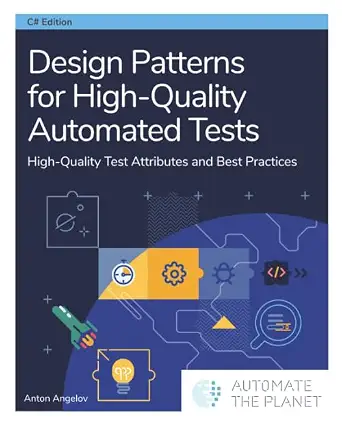
Design Patterns for High-Quality Automated Tests: High-Quality Test Attributes and Best Practices
Where most entries in this roundup teach you which tools to use, this one tackles the harder question of how to structure tests so they survive contact with a real codebase. Its focus on test attributes — reliability, maintainability, trustworthiness — is what separates it from tool-centric titles like Hands-On Automated Testing with Playwright, which assumes you’ll absorb good structure along the way. Readers who have already worked through Full Stack Testing will find this book drills deeper into the craft of writing tests that don’t flake or rot. The tradeoff is deliberately tool-agnostic content: there’s no framework setup guide here, and junior testers may find the abstraction level frustrating without a companion hands-on book. For teams whose test suites have become a liability, though, this is the refactoring manual the market under-supplies.
Pros:- Tool-agnostic principles that outlast any framework choice
- Directly addresses flaky, brittle, and unmaintainable test suites
- Framework-level thinking that scales across teams
- Strong complement to any tool-specific book in this roundup
Cons:- Too abstract for beginners who need concrete tool walkthroughs
- No hands-on exercises or framework tutorials
- Limited community discussion or reviews to gauge fit beforehand
Best for: Engineers and QA leads maintaining large, aging test suites that need structural improvement, not new tools
Not ideal for: Tool-seekers who want step-by-step framework setup — this assumes you already automate tests somewhere
- Format:Kindle / Paperback
- Focus:Test design patterns and best practices
- Tool Dependency:Tool-agnostic
- Core Topics:Test attributes, maintainability, reliability
- Experience Level:Intermediate to advanced
- ASIN:B085KR3XQ9
Our verdict“Buy this once you know a framework and start feeling the pain of badly structured tests — it’s the architecture book, not the starter book.”
Playwright Automation Testing Cheat Sheet: Master Playwright Automation from Fundamentals to Enterprise Frameworks
This is the roundup’s speed option: a condensed reference that gets a working tester productive in Playwright without wading through 400 pages of narrative. Compared with Hands-On Automated Testing with Playwright, which builds understanding chapter by chapter, this cheat sheet optimizes for fast lookup and rapid onboarding — the format engineers actually reach for mid-task. It spans fundamentals through enterprise-level framework design, which is unusually wide ground for a compact format. That compression is also the central tradeoff: examples stay thin, and anyone learning Playwright from zero will likely need a fuller tutorial alongside it. Paired with Design Patterns for High-Quality Automated Tests for structure theory, though, it covers the practical half of the equation efficiently. This pick makes the most sense as a desk-side companion rather than a primary textbook.
Pros:- Scannable format built for quick problem-solving
- Covers everything from basics to enterprise framework structure
- Serves both newcomers reviewing syntax and veterans checking patterns
- Cheaper and faster to consume than full-length Playwright titles
Cons:- Sparse worked examples limit hands-on learning
- Too condensed to serve as a sole learning resource
- Enterprise patterns get surface-level treatment only
Best for: Working automation engineers switching to Playwright from Selenium or Cypress who need fast, scannable answers
Not ideal for: Complete beginners who need guided tutorials and worked examples — the condensed format skips the scaffolding
- Format:Kindle / Paperback
- Framework:Microsoft Playwright
- Coverage:Fundamentals through enterprise frameworks
- Format Style:Condensed cheat sheet
- Experience Level:Beginner-friendly reference, best with prior testing exposure
- ASIN:B0HH9KRF7N
Our verdict“Grab this as your second Playwright book — ideal for daily reference once you understand the basics.”
Full Stack Testing: A Practical Guide for Delivering High Quality Software
This book earns its spot by zooming out where others zoom in. Rather than teaching one framework, it maps testing strategy across an entire technology stack — a perspective no tool-specific entry like Playwright Automation Testing Cheat Sheet can offer. This option stands out for teams deciding where to invest testing effort, not just how to write a selector. Compared with Design Patterns for High-Quality Automated Tests, which goes deep on test code quality, this book is broader: it covers tooling choices, process, and quality practices that span roles, making it a strong pick for QA leads and developers sharing responsibility for quality. The tradeoff is that breadth leaves little room for detailed code — hands-on readers will want a companion title for implementation. Anyone expecting copy-paste recipes will be disappointed; anyone building a team-wide quality culture will not.
Pros:- Stack-wide perspective no single-framework book provides
- Practical strategy guidance for improving software delivery
- Accessible to both developers and dedicated testers
- Strong on tooling decisions and quality process, not just syntax
Cons:- Light on detailed code examples
- Can feel advanced for testers early in their careers
- Less useful if you only automate one layer of the stack
Best for: QA leads, tech leads, and cross-functional teams shaping an end-to-end testing strategy across their whole stack
Not ideal for: Readers who learn by typing code — the strategic focus means few concrete implementation examples
- Format:Paperback / Kindle
- Publisher:O’Reilly Media
- Focus:Full-stack testing strategy and quality practices
- Audience:Developers and testers
- Experience Level:Intermediate
- ASIN:1098108132
Our verdict“The right pick when your problem is strategy and coverage across a whole product, not mastering one framework.”
Hands-On Automated Testing with Playwright: Create Fast, Reliable, and Scalable Tests for Modern Web Apps with Microsoft’s Automation Framework
Of the Playwright titles in this roundup — and there are several — this one offers the most complete tutorial-style learning path, walking from setup through building tests that stay fast and reliable at scale. Compared with Playwright Automation Testing Cheat Sheet, this book trades quick-scan convenience for depth: real worked scenarios, framework-building guidance, and attention to scalability concerns like parallelization that cheat sheets compress away. It also differs from AI Testing with Python by staying firmly tool-first — no LLM experiments, just disciplined Playwright practice for modern web apps, including Chromium, Firefox, and WebKit coverage that Selenium-based books handle more awkwardly. The tradeoff is pacing: the middle chapters push into framework design that beginners may find steep, and prerequisites are left implicit. For developers committed to Playwright as a long-term stack, this is the foundational investment.
Pros:- Full tutorial arc from fundamentals to scalable framework design
- Playwright’s multi-browser support handled natively and thoroughly
- Emphasis on test reliability and speed, not just passing scripts
- Directly applicable to modern single-page web applications
Cons:- Advanced middle chapters can lose readers new to automation
- No stated prerequisites, so beginners may start underprepared
- Playwright-only focus limits reuse if your team uses Selenium
Best for: Web developers and automation engineers committed to Playwright who want one thorough book instead of scattered tutorials
Not ideal for: Absolute beginners with no JavaScript or web-dev background — the book assumes prerequisites it never spells out
- Format:Kindle / Paperback
- Framework:Microsoft Playwright
- Coverage:Setup through scalable enterprise test design
- Target Apps:Modern web applications
- Experience Level:Intermediate
- ASIN:B0FLXM657N
Our verdict“The strongest single-book choice for going from Playwright curious to Playwright proficient on a modern web codebase.”
Spec-Driven Software Testing with AI: Build Reliable Test Suites from Specifications with AI, Test Automation, TDD, API Testing, and CI/CD
Where most titles in this roundup teach a specific tool, this one takes a specification-first philosophy and layers modern AI assistance on top of it. That makes it a natural companion (or counterpoint) to AI Testing with Python: instead of leading with code, it leads with requirements as the source of truth, then shows how AI, TDD, API testing, and CI/CD pipelines flow from those specs. The payoff is traceability — tests that map back to documented behavior, which matters enormously in regulated or contract-heavy environments. The tradeoff is that it reads more like a methodology book than a hands-on tutorial; readers wanting copy-paste framework code will get less immediate gratification than the Ultimate Selenium WebDriver title provides. It also assumes comfort with existing dev workflows, so true newcomers may feel under-served.
Pros:- Specification-driven approach creates traceable, requirement-mapped test suites
- Combines AI techniques with TDD, API testing, and CI/CD in one workflow
- Goes beyond a single tool, so the concepts survive framework changes
- Suited to teams modernizing legacy test strategies with AI assistance
Cons:- No customer reviews or ratings yet, so quality is unverified by the market
- Methodology focus means fewer ready-to-run framework examples
- Too technical for readers new to automated testing concepts
Best for: QA leads and engineers in regulated industries who want tests traceable to specifications and want AI woven into an existing CI/CD pipeline
Not ideal for: Beginners without CI/CD or TDD background — the methodology-heavy framing skips foundational hand-holding
- Format:Digital/Print book
- Primary Topics:Spec-driven testing, AI-assisted testing, TDD, API testing, CI/CD
- Audience Level:Intermediate to advanced
- Tool Focus:Tool-agnostic methodology
- Use Case:Enterprise QA strategy and pipeline integration
- Prerequisites:Familiarity with dev workflows and CI/CD
- Customer Ratings:None available
Our verdict“Pick this if you want your test suites built from specifications with AI in the loop rather than another tool tutorial.”
Ultimate Selenium WebDriver for Test Automation: Build and Implement Automated Web Testing Frameworks Using Java, Selenium WebDriver and Selenium Grid for E-Commerce, Healthcare, EdTech, Banking, and SAAS
This is the most industry-targeted Selenium title in the lineup, and its differentiation is deliberate: where Absolute Beginner (Part 1) Selenium WebDriver teaches WebDriver fundamentals, this book jumps straight to building production-grade frameworks in Java with Selenium Grid for distributed, cross-browser execution at scale. The industry framing — banking, healthcare, e-commerce, SaaS — translates into domain-specific scenarios that generic tutorials never touch, which is useful if your interviews or sprint work live in those worlds. Compared with the Playwright titles in this roundup, the Java+Selenium stack is heavier to set up but remains the most demanded skill set in enterprise job postings. The cost is density: this assumes real Java fluency, and the sheer breadth means some chapters move fast.
Pros:- Covers full framework architecture, not just individual WebDriver commands
- Selenium Grid coverage enables distributed, parallel cross-browser testing
- Industry-specific scenarios for e-commerce, healthcare, EdTech, banking, and SaaS
- Aligns with the most common enterprise hiring requirements
Cons:- Assumes strong Java proficiency with little ramp-up material
- Selenium-based stacks carry heavier maintenance overhead than modern alternatives like Playwright
- Too dense for readers seeking a gentle introduction
Best for: Java developers and QA engineers building scalable frameworks for regulated or large-scale industry applications
Not ideal for: JavaScript-first developers or automation newcomers — the Java plus Grid setup curve is steep from page one
- Format:Print book
- Primary Language:Java
- Core Tools:Selenium WebDriver, Selenium Grid
- Focus:Framework design and implementation
- Industry Coverage:E-commerce, healthcare, EdTech, banking, SaaS
- Audience Level:Intermediate to advanced
- Testing Scope:Web UI automation, distributed execution
Our verdict“The strongest choice if your career or product lives in Java-based enterprise automation at scale.”
Absolute Beginner (Part 1) Selenium WebDriver for Functional Automation Testing
Every roundup needs an on-ramp, and this is it. The pitch is simple: learn functional automation testing from zero, with Selenium WebDriver concepts explained in plain language before any framework ambition enters the picture. Compared with Ultimate Selenium WebDriver for Test Automation, this book deliberately stops where that one begins — you get locators, waits, and basic scripts rather than Grid clusters or industry-scale architecture. That restraint is the point: readers who bounce off denser titles will actually finish this one. The tradeoffs are real, though. There are no accompanying practical exercises, so you’ll need to invent your own practice projects, and anyone past their first automation job will find nothing new. Think of it as tuition for the first month of a learning plan, to be followed by a design-patterns or framework book.
Pros:- Genuinely beginner-friendly pacing with plain-language explanations
- Builds correct foundational understanding of WebDriver mechanics
- Low-cost, low-commitment entry point before investing in bigger titles
- Focuses on functional testing fundamentals that transfer to other tools
Cons:- No practical exercises or sample projects included
- Part 1 scope means you must buy or learn further material to build real frameworks
- Content depth trails far behind advanced Selenium titles in this roundup
Best for: Manual testers and career-switchers writing their very first automation scripts
Not ideal for: Working automation engineers — the content ends well before framework design, CI integration, or advanced patterns begin
- Format:Digital book
- Series Position:Part 1 of a beginner series
- Core Tool:Selenium WebDriver
- Focus:Functional automation testing fundamentals
- Audience Level:Absolute beginner
- Exercises Included:No
- Prerequisites:Basic programming concepts helpful but not required
Our verdict“Buy this as your first step into automation, then graduate to a framework-focused book once the basics click.”
Web Automation Testing Using Playwright: End-to-end, API, Accessibility, and Visual Testing using Playwright (English Edition)
What separates this from other Playwright entries like Hands-On Automated Testing with Playwright is breadth across testing types: it treats end-to-end, API, accessibility, and visual testing as equal citizens of one framework rather than tacking them on as afterthoughts. That matters because modern teams increasingly expect a single tool to cover the full verification surface, and Playwright genuinely can. The accessibility and visual testing chapters are the standout — coverage most Selenium-focused titles, including the Ultimate Selenium WebDriver book, simply don’t attempt. The tradeoff is that breadth compresses depth: each testing type gets solid but not exhaustive treatment, and beginners without JavaScript fundamentals will find the early chapters move quickly. It functions best as the central Playwright reference on a team shelf, supplemented by deeper titles where needed.
Pros:- Covers four testing disciplines — end-to-end, API, accessibility, and visual — in one framework
- Reflects modern practice of consolidating verification into a single tool
- Accessibility and visual testing guidance is rare among Playwright books
- Directly relevant to both developers and dedicated testers
Cons:- Breadth limits depth on any single testing type
- Unclear edition and publication date makes currency of content hard to verify
- Assumes JavaScript comfort, which can exclude automation-first QA testers
Best for: Developers and QA engineers standardizing on Playwright who want one book covering their entire testing surface
Not ideal for: Complete beginners without JavaScript basics, or teams committed to Selenium-based Java stacks
- Format:Print/digital book (English Edition)
- Core Tool:Playwright
- Testing Types Covered:End-to-end, API, accessibility, visual
- Audience Level:Intermediate
- Prerequisites:JavaScript fundamentals
- Scope:Web automation across multiple testing disciplines
- Edition Info:Publication date not specified
Our verdict“The most complete single-volume Playwright option here — choose it when coverage breadth beats deep specialization.”

How We Picked
I evaluated each book against criteria that reflect how developers and QA engineers actually learn and apply automated testing: framework relevance in 2026 (Playwright and AI-assisted workflows score higher than aging Selenium-only material), depth of practical examples (runnable code beats conceptual diagrams), and coverage of the full testing lifecycle including CI/CD integration, API testing, and maintainability. I also weighed audience fit — a book that perfectly serves absolute beginners ranks highly for that niche even if it lacks enterprise patterns, and vice versa.
Ranking order follows a simple logic: books that combine a modern framework, hands-on depth, and career-scale relevance rise to the top, while narrowly scoped or dated titles slot lower despite being solid within their lane. Where two books cover the same framework, the one with broader lifecycle coverage and fresher editions wins, with the runner-up recommended for its specific audience rather than dropped entirely.
Factors to Consider When Choosing Automated Testing Frameworks
Choosing a book on automated testing frameworks is really choosing a learning path, and the wrong pick can waste weeks. Before buying, think through these factors — they matter more than page count or star ratings.Match the Framework to Your Career Direction
The single biggest mistake buyers make is learning a framework their target employers don’t use. Playwright skills are currently the fastest-growing demand in job postings, while Selenium remains the entrenched standard in large enterprises and regulated sectors like banking and healthcare — a pattern visible in this roundup’s Selenium titles. Robot Framework occupies a stable niche in European enterprise and hardware-adjacent testing. If you’re uncertain, favor books that teach transferable concepts (locators, waits, page object models) over framework-specific syntax, because the underlying skills outlive any single tool. A common regret I see flagged in reader reviews is investing deeply in a book tied to a declining toolchain with no transferable framing.
Decide How Much AI Coverage You Need
Books published before roughly 2024 treat AI-assisted testing as an afterthought or skip it entirely, while newer titles build entire workflows around LLMs for test generation and spec-driven suites. Neither approach is wrong, but the mismatch between expectation and content is the most frequent complaint in this category. If your team is already experimenting with AI coding assistants, a book like the spec-driven approach will feel current; if you’re solidifying fundamentals first, AI-heavy content can distract from core skills you haven’t built yet. My guidance: master manual test design logic before automating it with AI, because AI-generated tests are only as good as the human judgment validating them.
Breadth Versus Depth — and When Each Pays Off
Full-stack testing books promise end-to-end coverage: unit, integration, API, UI, performance, and security in one volume. That breadth is valuable for test leads and architects who need shared vocabulary across layers, but individual contributors often finish these books feeling they learned terminology rather than buildable skills. Depth-focused books — the single-framework titles in this roundup — get you writing production tests within days but leave gaps when your role expands. A practical rule: buy one breadth book for your shelf and one depth book for your daily workflow, rather than expecting a single title to serve both purposes. Also check whether multi-edition books actually revised their content or just reprinted with a new date, a common issue with the Full Stack Testing titles.
Language Prerequisites Are Non-Negotiable
Automated testing books are really programming books in disguise, and the language choice determines whether you’ll finish them. Selenium titles split between Java and other languages — the enterprise-focused Java books assume comfort with Maven, TestNG, and OOP patterns, and struggling with Java fundamentals while learning automation is a recipe for abandonment. Playwright books lean on TypeScript/JavaScript, which is gentler if you have any web development background. Python-based titles (Test-Driven Development with Python, AI Testing with Python) suit data-adjacent engineers but can frustrate front-end devs. Be honest about your strongest language and buy accordingly — the framework concepts transfer later, but only if you actually complete the book.
Check the Maintenance and Longevity Factor
Framework APIs change fast, and a book written against a two-year-old Playwright or Selenium version can have broken examples that cost hours to debug. Before purchasing, check the publication date against the framework’s current release notes, and look at whether the author maintains a companion code repository with updates — authors who do are effectively extending the book’s lifespan. The other longevity angle is conceptual: books on test design patterns and quality attributes age slowly because principles like isolation, determinism, and readability don’t depend on API versions. If budget allows one book, bias toward principle-heavy titles and supplement with free official documentation for current syntax.
Frequently Asked Questions
Should I learn Playwright or Selenium in 2026?
For most new learners, Playwright is the stronger starting point: it offers auto-waiting, multi-browser support out of the box, faster execution, and a single API across languages, which removes the flakiness problems that consume so much Selenium debugging time. Selenium still makes sense if your current employer standardizes on it, if you’re targeting Java-heavy enterprise roles, or if you work in regulated industries where Selenium Grid infrastructure already exists — the enterprise-focused Selenium books in this roundup exist precisely for that audience. The reassuring part is that the concepts overlap heavily: locators, waits, page objects, and CI integration transfer between them. Learning one well and picking up the other later typically takes days, not months, so the decision is lower-stakes than it feels.
Do I need to know how to code before buying one of these books?
It depends on the title, and this is where buyers most often go wrong. Beginner-marketed books like the Absolute Beginner Selenium volume assume zero scripting and teach syntax alongside automation concepts, though you’ll still move faster with basic programming literacy. Mid-level and advanced titles — particularly the design patterns book, the enterprise Playwright guides, and the Java-based Selenium handbook — assume you can read and modify code comfortably and will feel impenetrable otherwise. A reasonable benchmark: if you can write a loop, a function, and a conditional in any language, most books here are accessible. If not, spend two weeks on a language fundamentals course first, then buy the automation book; otherwise you’ll blame the book for a prerequisite gap it never promised to fill.
Are the AI-powered testing books worth it, or is that just hype?
The legitimate value is real but narrower than marketing suggests. AI Testing with Python and Spec-Driven Software Testing with AI are worthwhile because they teach durable workflows — generating test cases from specifications, using LLMs for test maintenance, and integrating AI tooling into CI pipelines — rather than promoting a single tool that may not exist next year. Where AI testing books disappoint is when they treat AI as a replacement for test design judgment; generated tests that encode wrong assumptions fail confidently and quietly. If your team already uses AI coding assistants, these books will sharpen practices you’ve started improvising. If you haven’t yet built solid manual test design skills, fundamentals books deliver more return per dollar right now, and the AI titles will still be relevant when you’re ready.
Why do two books in this roundup have nearly identical titles, and which should I buy?
The two Full Stack Testing titles reflect a common pattern in tech publishing: an original edition followed by a revised one with an updated subtitle, in this case the version updated for the age of AI. The revised edition is generally the better buy because its examples reflect current tool versions and it addresses AI-assisted workflows the original couldn’t. Before choosing, verify which edition a storefront is actually shipping, since listings frequently mix editions and reviews get cross-posted between them. The same diligence applies to the overlapping Playwright titles: one is a compact reference-oriented guide, the other a full tutorial, and they serve different reading styles rather than competing directly. Checking the table of contents against your current project needs settles it faster than publication date alone.
Can one book cover testing for my whole team, or should different roles buy different titles?
One book rarely serves a whole team well because automation books are written for distinct jobs. QA engineers writing daily tests get the most from hands-on, single-framework tutorials; test architects and leads benefit from the breadth-and-patterns titles that cover maintainability, test pyramids, and strategy; developers doing TDD need the test-driven development books that treat testing as a design discipline rather than a QA activity. A practical approach for teams: standardize on one framework-specific book for hands-on practitioners and one principles book shared across roles, then let specialists add their own. This mirrors how the roundup assigns roles, and it avoids the common failure mode of everyone owning the same enterprise tome that only two people ever finish.
Conclusion
The right pick here depends less on which framework is objectively best and more on where you are in your testing career. For best overall, Hands-On Automated Testing with Playwright delivers the best balance of modern tooling, practical depth, and career relevance for most buyers. For best value, Absolute Beginner (Part 1) Selenium WebDriver gets true novices productive for the lowest investment, while Design Patterns for High-Quality Automated Tests is the best long-term value since its principles outlive any framework choice. For best premium pick, Ultimate Selenium WebDriver for Test Automation justifies its higher commitment for engineers targeting enterprise and regulated-industry roles. For beginners specifically, pair the Absolute Beginner title with Test-Driven Development with Python if you want testing woven into how you write software from day one. For specific needs: choose AI Testing with Python for AI-augmented workflows, Mastering Test Automation with the Robot Framework for keyword-driven team collaboration, the revised Full Stack Testing for test leads wanting whole-lifecycle breadth, and Web Automation Testing Using Playwright if accessibility and visual testing are part of your mandate. Whichever you choose, commit to building something real with it — that’s where every one of these books pays off.
Halloween Picks
halloween
As an affiliate, we earn on qualifying purchases.