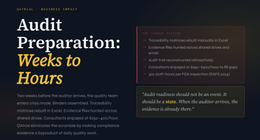
Why a six-stage document lifecycle with automated retraining is essential for every regulated organization.
The SOP That Was Not Current
During an FDA inspection of a mid-market pharmaceutical manufacturer, an investigator asked to see the SOP for aseptic gowning in the sterile fill area. The quality manager pulled up the document control system and presented SOP-MFG-042, Revision 7, effective date January 15, 2024.
The investigator then walked to the gowning area and observed the procedure being performed. The technique did not match the SOP. When the investigator questioned the operator, the operator described the procedure from Revision 5 — the version they had been trained on 18 months earlier.
Revision 6 had introduced a new glove change procedure. Revision 7 had modified the goggle decontamination step. Neither revision had triggered retraining for the fill operators. The document control system showed both revisions as “effective.” The training system showed the operators as “compliant” — against Revision 5.
The resulting FDA Form 483 observation cited failures in document control (21 CFR 211.100) and training (21 CFR 211.25). The CAPA consumed 14 weeks and 600 person-hours. But the real cost was the consent decree negotiation that this finding contributed to — one of three systemic findings that demonstrated inadequate quality system controls.
This scenario is preventable. It persists because most companies treat document control and training management as separate processes served by separate systems with no automated linkage between them.
in Document
Control
of findings from Stage 4 gap
document control software for regulated industries
As an affiliate, we earn on qualifying purchases.
As an affiliate, we earn on qualifying purchases.
The Document Lifecycle Most Companies Think They Have
Ask any quality manager to describe their document lifecycle, and you will hear something like this: documents are drafted, reviewed, approved, and made effective. When they need updating, they are revised, re-reviewed, re-approved, and the new version becomes effective. Old versions are archived.
This four-stage model — draft, review, approve, effective — is inadequate for regulated environments. It describes what happens to the document but not what happens to the organization when the document changes.
SOP management system with automated retraining
As an affiliate, we earn on qualifying purchases.
As an affiliate, we earn on qualifying purchases.
The Six-Stage Lifecycle That Actually Works
An effective document lifecycle for regulated industries includes six stages, each with defined system behaviors and quality implications.
Stage 1: Draft
The document is created or revised by the author. In QAtrial, the draft stage supports collaborative editing with version tracking. Multiple authors can contribute to a draft without creating the confusion of email attachments and conflicting copies. The system maintains a single source of truth with full change history.
Critically, draft documents are not visible to end users. Only the current effective version is accessible to personnel who execute the procedure. This prevents the dangerous situation where someone accidentally follows a draft instead of the approved version.
Stage 2: Review
The draft is routed to designated reviewers based on document type, department, and content classification. QAtrial supports parallel and sequential review workflows. Reviewers provide comments, request changes, or approve the document. All review activity is captured in the audit trail.
Review cycles in regulated environments average 10 to 15 business days for routine SOPs and 20 to 30 days for cross-functional documents. QAtrial tracks review cycle time and escalates overdue reviews automatically, preventing the review bottleneck that causes document backlogs.
Stage 3: Approval
Approved documents receive electronic signatures from designated approvers. QAtrial’s electronic signature implementation satisfies 21 CFR Part 11 requirements — each signature captures the signer’s identity, the date and time, the meaning of the signature (authored, reviewed, approved), and a legally binding acknowledgment.
Approval workflows are configurable by document type. A work instruction may require only a department manager’s approval. A quality policy may require signatures from the VP Quality, VP Operations, and VP Regulatory Affairs.
Stage 4: Effective
This is where the critical transition occurs. When a document becomes effective, three things must happen simultaneously.
The new version must become the accessible version for all personnel. The previous version must be superseded and removed from active circulation. And every person who was trained on the previous version must be identified and assigned retraining on the new version.
In most companies, the first two actions happen reliably. The third does not. The link between document effectiveness and training assignment is the gap that generates 40 percent of audit findings.
QAtrial closes this gap programmatically. When a document transitions to “effective” status, the system automatically queries the training matrix, identifies all personnel trained on the previous version, creates retraining assignments with appropriate due dates, and notifies affected personnel and their managers. No manual intervention is required.
Stage 5: Periodic Review
Every controlled document must be reviewed periodically to confirm it remains current and accurate. ISO 13485 does not specify the review frequency, but industry practice ranges from annual review for critical SOPs to biennial review for supporting documents.
QAtrial tracks periodic review dates for every controlled document and generates review assignments automatically. When a periodic review is due, the system assigns the review to the document owner, tracks completion, and records the outcome — either “confirmed current” or “revision required.”
This is the stage that most companies manage poorly. Without automated tracking, periodic reviews are forgotten until an auditor asks, “When was this SOP last reviewed?” If the answer is “three years ago,” the finding writes itself.
Stage 6: Retirement
When a document is no longer needed — because a process has been discontinued, a product has been retired, or the content has been consolidated into another document — it must be formally retired. Retirement is not deletion. The document remains in the system for historical reference but is no longer available for active use and no longer generates training requirements or periodic review obligations.
QAtrial manages retirement as a formal lifecycle stage with its own approval workflow. The retirement record documents the reason for retirement and identifies any replacement documents. Training records associated with the retired document are archived but preserved for regulatory reference.
training management software for pharmaceutical companies
As an affiliate, we earn on qualifying purchases.
As an affiliate, we earn on qualifying purchases.
The Supersession Problem
Superseded documents are a particular risk in regulated environments. A superseded document is one that has been replaced by a newer version. It is no longer current, but it may still exist in printed form, in email archives, in shared drives, or in binders at workstations.
FDA inspectors routinely check for superseded documents in production areas. The presence of an old revision at a workstation is a finding — it demonstrates inadequate document control regardless of whether the operator was actually using the outdated version.
QAtrial addresses supersession through several mechanisms. Electronic distribution eliminates paper copies. When a document is revised, the previous version is automatically marked as superseded and becomes inaccessible through normal system navigation. Only quality administrators can access superseded versions, and only through a specific historical search function.
For environments that still require printed documents at point of use — and many manufacturing environments do — QAtrial’s print control module tracks issued copies and generates recall notifications when a document is superseded. The recall notification identifies every location where a controlled copy was issued and requires acknowledgment that the superseded copy has been retrieved and destroyed.

Engineering Compliance Manager: Journal, Notes, Ideas, Actions, Priorities, Checklists, Log | Tool for Daily Goal Setting Tracker | Time Management | … | Project Office Book Gifts for Meetings
As an affiliate, we earn on qualifying purchases.
As an affiliate, we earn on qualifying purchases.
The Velocity of Change
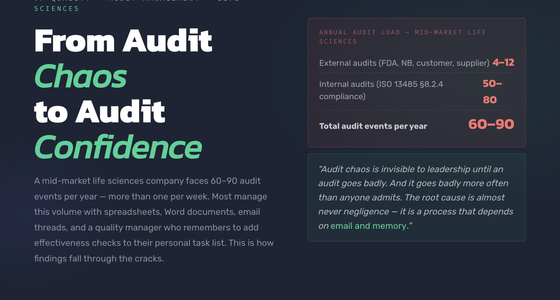
The document lifecycle challenge is compounded by the velocity of change in modern regulated environments. A mid-market life sciences company with 1,000 controlled documents and an 18-month average revision cycle will process approximately 55 document revisions per month. Each revision potentially affects 10 to 30 trained personnel.
That is 550 to 1,650 training events generated by document changes alone — every month. Add new hire onboarding, periodic retraining, and competency-based training requirements, and the monthly training volume can exceed 2,000 events.
No manual process can manage this volume reliably. The training coordinator who tracks assignments in a spreadsheet will miss assignments. The document controller who sends email notifications about superseded documents will miss recipients. The quality manager who schedules periodic reviews in a calendar will miss due dates.
These are not failures of individual performance. They are failures of system design. Manual processes cannot scale to the document velocity of a modern regulated organization.
The Cost of Document Control Failures
Document control findings are among the most common and most consequential audit observations in regulated industries.
FDA warning letters citing 21 CFR 820.40 (document controls) appear in approximately 25 percent of all medical device warning letters. EU notified body audit reports cite document control deficiencies in roughly 30 percent of audits. ISO 13485 certification audits identify document control findings in an estimated 35 percent of surveillance audits.
The remediation cost for a systemic document control finding — one that requires a comprehensive review of the document control system, not just correction of a single document — ranges from $50,000 to $250,000 in direct labor costs. Add the indirect costs of management attention, regulatory communication, and potential delays to product approvals, and the total impact can exceed $500,000.
A robust document lifecycle management system prevents these findings by design. When the system enforces the six-stage lifecycle, automates supersession control, triggers retraining on revision, and tracks periodic reviews, the audit finding disappears — not because the company is working harder, but because the system eliminates the gaps that generate findings.
Building the Business Case
The business case for automated document lifecycle management rests on three pillars.
Risk reduction through elimination of supersession errors, training gaps, and missed periodic reviews. Quantified by the expected cost of audit findings avoided: $100,000 to $500,000 per audit cycle.
Operational efficiency through elimination of manual tracking, notification, and compliance reporting. Quantified by the reduction in document control and training administration labor: 1 to 3 FTEs for a mid-market company, representing $80,000 to $250,000 annually.
Speed to compliance for new and revised documents. Quantified by the reduction in document review cycle time: typically 30 to 50 percent improvement through automated routing, parallel review, and escalation.
QAtrial delivers these benefits at an infrastructure cost of $200 to $500 per month, with no license fees and no per-user charges. The return on investment is measured in weeks, not years.
The VP Quality’s Responsibility
Document control is the foundation of every regulated quality system. When document control fails, training fails. When training fails, execution fails. When execution fails, products fail.
If your document lifecycle has four stages instead of six, if your supersession control depends on manual retrieval, and if your retraining trigger depends on a coordinator remembering to check — your foundation has cracks.
QAtrial’s six-stage document lifecycle is available today. Deploy it, configure your document types and workflows, and close the gaps that your next auditor will look for.
Implement six-stage document lifecycle management with QAtrial at github.com/MeyerThorsten/QAtrial. Your SOPs change. Make sure your organization keeps up.