How automated training management eliminates the most common audit finding in regulated industries.
The Finding That Will Not Go Away
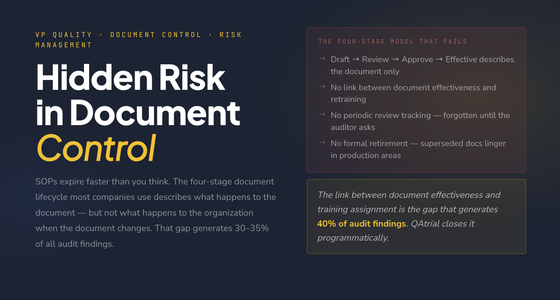
Audit after audit, inspection after inspection, the same finding appears: personnel were not trained on the current version of the procedure they were executing. In FDA warning letters, EU notified body audit reports, and ISO 13485 certification audits, training deficiencies account for approximately 40 percent of all findings.
This is not a new problem. It has been the leading audit finding category for over a decade. And despite every regulated company claiming that training is a priority, the gap persists — because the tools and processes most companies use to manage training are fundamentally inadequate for the scale and velocity of change in a modern quality system.
Compliance Gap
are about training
noncompliance
management systems
and notification
post-implementation
effectiveness evaluation
The training compliance gap is not a people problem. It is a systems problem. And it is costing companies millions in audit remediation, delayed product launches, and operational disruption.

Automated Software Testing: Introduction, Management, and Performance: Introduction, Management, and Performance
As an affiliate, we earn on qualifying purchases.
As an affiliate, we earn on qualifying purchases.
The Anatomy of a Training Failure
Understanding why training compliance fails requires understanding how training requirements are generated in a regulated environment.
Every standard operating procedure, work instruction, and quality policy has a training requirement. When a document is created, the personnel who execute that procedure must be trained on it. When a document is revised, those same personnel must be retrained on the new version. When a new employee joins the organization, they must complete all training requirements for their role before performing regulated work.
In a typical mid-market life sciences company, the quality management system contains 500 to 2,000 controlled documents. Each document has an average of 10 to 30 trained personnel. The average document revision cycle is 18 to 24 months. New employees are hired at a rate of 5 to 15 per month.
This generates a continuous stream of training events — 200 to 500 per month for a 300-person organization. Each event requires assignment, completion, documentation, and verification. Each must be completed within a defined timeframe. And each must be traceable in the training record for the life of the employee’s tenure.
Now consider what happens when this volume of training activity is managed with spreadsheets, shared drives, and email reminders.
Training assignments are created manually by a training coordinator who monitors document control for new or revised SOPs. The coordinator identifies the affected personnel from a role-based training matrix — itself a spreadsheet that must be manually maintained. Email notifications are sent. Completion is tracked in a log. Overdue training is identified during periodic compliance checks.
At every step, there is a gap where the process depends on human attention, human memory, and human follow-through. The training coordinator goes on vacation. An SOP revision is published on a Friday afternoon and the training assignment is not created until the following week. A new hire’s training matrix is incomplete because their role spans two departments and only one department’s coordinator was notified.
These are not failures of diligence. They are failures of architecture. Manual training management cannot keep pace with the volume and velocity of training requirements in a modern quality system.

HIPAA Package for Medical and Dental Offices Including Regulations and Standards Manual (hardcopy) + Policies and Forms (hardcopy and USB) + Training Outline and Test + Resource USB + Posters
A HIPAA compliance solution for healthcare providers like medical offices, dental offices and more
As an affiliate, we earn on qualifying purchases.
As an affiliate, we earn on qualifying purchases.
The Cost of Noncompliance
Training findings are not benign. They carry direct and indirect costs that accumulate rapidly.
Direct audit remediation costs include the CAPA required to address the finding, the root cause investigation, the effectiveness check, and the management review. For a major training finding at an FDA inspection, the remediation effort typically consumes 200 to 500 person-hours of quality, training, and operations staff time. At a fully loaded cost of $75 per hour, that is $15,000 to $37,500 per finding.
Companies with systemic training issues may face 5 to 15 training-related findings in a single audit. Total remediation cost: $75,000 to $500,000.
Indirect costs are larger. An FDA Form 483 observation related to training adequacy can delay product approvals, trigger additional inspections, and damage the company’s regulatory reputation. For a company awaiting a PMA decision or a facility clearance, a training-related delay can cost millions in deferred revenue.
In extreme cases, training deficiencies contribute to consent decrees. FDA consent decrees routinely include requirements for comprehensive retraining of all personnel at affected facilities — a remediation effort that can cost $2 million to $10 million and take 12 to 24 months to complete.

The ABC of CAPA: A Step-by-Step Guide To Corrective and Preventive Action Management
As an affiliate, we earn on qualifying purchases.
As an affiliate, we earn on qualifying purchases.
The Automated Training Management Solution
Automated training management eliminates the gaps in manual processes by connecting document control events directly to training workflows without human intermediation.
QAtrial’s training management module operates on a simple but powerful principle: when a controlled document changes status, the training implications are calculated and executed automatically.
Document-Triggered Training Assignment
When an SOP is revised and approved in QAtrial’s document control module, the system automatically identifies all personnel who were trained on the previous version. It creates training assignments for each affected person with the new version. It sets due dates based on configurable rules — 30 days for routine revisions, 7 days for safety-critical changes. And it sends notifications through the system’s alert framework.
No training coordinator intervention is required. No email is composed manually. No spreadsheet is updated. The document lifecycle event triggers the training cascade programmatically.
Role-Based Training Matrices
QAtrial maintains training matrices as structured data, not spreadsheets. Each role in the organization is mapped to the set of documents that role requires. When a new employee is assigned to a role, the system generates the complete set of initial training assignments automatically. When a role definition changes — a new SOP is added to the requirements, or a responsibility is transferred between roles — all personnel in the affected role receive updated assignments.
This eliminates the most common source of training gaps: the new hire whose matrix was incomplete, or the experienced employee whose role expanded without a corresponding update to their training requirements.
Compliance Dashboard and Escalation
QAtrial’s training compliance dashboard provides real-time visibility into the training status of every person in the organization. It shows current compliance percentage by department, by role, and by individual. It flags overdue training with escalating urgency levels. It projects upcoming training due dates to enable proactive scheduling.
When training becomes overdue, the system escalates automatically. First notification goes to the employee. Second notification goes to their manager. Third notification goes to the quality director. This escalation chain is configurable and auditable.
For VP Quality leaders, the dashboard answers the question that auditors will ask: “Show me your current training compliance status.” The answer is available in seconds, not hours of spreadsheet compilation.
Automatic Retraining on Document Changes
The most critical capability is the automated link between document revisions and retraining. In manual systems, this link is the most common point of failure. A document is revised, but the training coordinator is not notified. Or the coordinator is notified but does not create assignments until the following week. Or assignments are created but the training matrix is outdated, so some affected personnel are missed.
QAtrial eliminates all of these failure modes. The document revision event is the training trigger. The training matrix is the assignment source. The calculation is automatic, immediate, and complete.

Write for Business (Write Source 2000 Revision)
Used Book in Good Condition
As an affiliate, we earn on qualifying purchases.
As an affiliate, we earn on qualifying purchases.
Measuring the Impact
A 300-person pharmaceutical company implemented automated training management and measured the following results over 12 months.
Training compliance rate improved from 78 percent to 97 percent. The 78 percent baseline is typical for companies using manual training management — and it is the number that generates audit findings.
Time to complete training assignments after document revision decreased from an average of 23 days to 9 days. The improvement was driven entirely by faster assignment creation and more effective notification — the actual training time per person was unchanged.
Training-related audit findings decreased from 8 findings in the prior audit cycle to 1 finding. The single remaining finding was related to training effectiveness evaluation, not assignment or completion.
Training coordinator administrative time decreased by 60 percent. The coordinator’s role shifted from manual assignment creation and compliance tracking to training content development and effectiveness evaluation — higher-value activities.
Annual cost savings from reduced audit remediation, reduced administrative labor, and avoided regulatory delays: approximately $200,000.
The Technology Requirements
Effective automated training management requires specific technical capabilities that spreadsheets and standalone LMS platforms cannot provide.
It requires tight integration with document control. Training assignments must be triggered by document lifecycle events. If the training system and the document system are separate platforms connected by a nightly batch file, the gap between document approval and training assignment creation is a compliance risk.
It requires a structured, queryable training matrix. Role-to-document mappings must be maintained as data, not as rows in a spreadsheet. The system must support complex role hierarchies and multi-department assignments.
It requires electronic signatures for training completion. “I read and understood” acknowledgments must be captured with the same rigor as any other electronic signature in the quality system — user authentication, timestamp, and meaning declaration.
It requires an audit trail. Every training assignment, completion, and overdue escalation must be recorded in an immutable log that auditors can review.
QAtrial provides all of these capabilities in an integrated platform. Because training management is part of the same system as document control, supplier management, complaint handling, and CAPA management, the connections between these modules are native — not bolted on through integrations.
The VP Quality’s Priority
If 40 percent of your audit findings are about training, your training management system is your highest-risk quality process. And if that system runs on spreadsheets and email, the risk is structural.
Automated training management is not a luxury for large enterprises. It is a necessity for any regulated company that wants to close its most persistent audit gap.
QAtrial delivers this capability at no license cost, with the integration depth that standalone LMS platforms cannot match and the audit trail rigor that spreadsheets cannot provide.
Your people are your most important quality asset. Give them a system that keeps them qualified.
Deploy automated training management with QAtrial at github.com/MeyerThorsten/QAtrial. Close the training gap before your next audit opens it.